
Author: Hiren Bhuriya

  • Delta Flight DL275 Diverted LAX: What Happened and Why It Matters

    Delta Flight DL275 Diverted LAX: What Happened and Why It Matters

    On the night of May 27, 2025, hundreds of passengers aboard an Airbus A350 found their transpacific journey unexpectedly redirected. Delta Flight DL275 diverted LAX instead of completing its scheduled route to Tokyo Haneda, a decision that made headlines across aviation circles and raised important questions about flight safety, airline protocols, and passenger rights. This article presents a complete, fact-based account of the incident, drawing from verified aviation data, airline communications, and established safety guidelines.

    Flight Background: Detroit to Tokyo — A Critical Trans-Pacific Route

    Delta Flight DL275 is one of Delta Air Lines’ key long-haul international services, operating the Detroit Metropolitan Airport (DTW) to Tokyo Haneda Airport (HND) corridor. The route typically spans approximately 13 hours across North America and the North Pacific Ocean, carried out by an Airbus A350-900, a state-of-the-art wide-body aircraft engineered for fuel efficiency, passenger comfort, and advanced onboard safety monitoring.

    The A350-900 is equipped with Rolls-Royce Trent XWB engines and features a sophisticated suite of real-time diagnostic systems that continuously track every critical aircraft function, from fuel pressure and hydraulics to environmental and de-icing systems. These capabilities are central to understanding how the DL275 incident unfolded.

    What Triggered the Diversion? The Engine Anti-Ice System Explained

    The primary technical reason Delta Flight DL275 diverted LAX was a cockpit warning linked to the aircraft’s engine anti-ice system  a critical component for Pacific crossings.

    At cruising altitude over the North Pacific, outside air temperatures regularly plunge below -50°C (-58°F). In such conditions, ice can form on engine inlet surfaces, disrupting airflow and reducing engine efficiency. To counter this, modern jet engines use anti-ice systems that channel warm air from within the engine onto vulnerable surfaces, preventing ice accumulation before it can affect performance.

    Several hours into the flight  while the aircraft was still operating normally  the cockpit monitoring system flagged an anomaly in the anti-ice system’s behavior. Critically, this was not an engine failure. The aircraft was flying steadily at altitude, and passengers were not in immediate danger. However, the alert indicated that the system might not be functioning reliably under the extreme conditions ahead over the Pacific.

    Aviation safety doctrine is clear on such situations: when in doubt, act decisively and conservatively. The crew consulted Delta’s operations centre and air traffic control and determined that continuing across thousands of miles of open ocean without a verified, fully operational anti-ice system was not acceptable. The decision to divert was made  and it was the right one.

    Why Los Angeles International Airport (LAX)?

    Choosing a diversion airport for a heavy, fuel-laden wide-body jet requires careful consideration of several variables: runway length, maintenance capability, airline infrastructure, proximity, and air traffic control coordination. LAX checked every box.

    As one of the busiest and best-equipped airports in the world, LAX offers:

    Runway Capacity: Long, reinforced runways capable of safely accepting a fully loaded Airbus A350, which at intercontinental fuel loads can weigh over 280 tonnes at landing.

    Delta Maintenance Hub: Delta Air Lines maintains extensive maintenance teams and spare parts inventory at LAX, making it ideal for technical inspections of aircraft like the A350.

    Medical & Emergency Services: LAX is equipped with top-tier emergency response teams capable of responding to any situation upon landing.

    Passenger Re-accommodation: As a major international gateway, LAX offers onward flight connections to Japan and Asia, minimising disruption to passengers’ final destinations.

    After a five-hour flight from the point of diversion, Delta Flight DL275 diverted LAX and landed safely without incident, precisely as the crew had planned.

    The Timeline: From Alert to Safe Landing

    Based on flight tracking data and airline communications, the sequence of events was as follows:

    Departure (approx. 1:15 PM EDT): DL275 departs Detroit Metropolitan Airport on schedule, heading northwest.

    Cruise Phase (Hours 4–6): Passengers are settled into the long flight. Meals served. Anti-ice warning detected in the cockpit.

    Crew Evaluation & Decision: Pilots consult airline operations and air traffic control. Decision is made to divert to LAX.

    Southward Turn: The aircraft changes course, visible to flight-tracking users on Flightradar24 and FlightAware.

    LAX Approach & Landing (approx. 1:38 AM PDT): After approximately 12 hours total airborne time, DL275 lands safely at Los Angeles International Airport.

    Cabin crew communicated regularly and transparently throughout, keeping passengers informed and calm. Delta’s ground teams at LAX were ready to receive the aircraft immediately upon arrival.

    Passenger Rights and Delta’s Duty of Care

    For those on board when Delta Flight DL275 diverted LAX, the immediate concern after landing was: what happens next?

    Because the diversion was caused by a mechanical issue — a controllable event under airline responsibility — passengers were entitled to significant support under Delta’s Contract of Carriage and U.S. Department of Transportation guidelines. Delta provided:

    Hotel Accommodation: Overnight hotel rooms for affected passengers who could not immediately re-board.

    Meal Vouchers: Food and beverage allowances for the duration of the disruption.

    Rebooking Assistance: Priority rebooking on the next available flights to Tokyo Haneda, including connections via Seattle (SEA) and San Francisco (SFO).

    SkyMiles Compensation: Many passengers received goodwill miles or travel credits as a customer service gesture.

    Travel insurance holders  particularly those with ‘trip interruption’ or ‘delay’ coverage  may also have been eligible for additional reimbursement for out-of-pocket expenses, depending on the policy’s terms.

    Aviation Safety in Practice: Why Diversions Signal a Healthy System

    One of the most important takeaways from Delta Flight DL275 diverted LAX is what it reveals about modern aviation safety culture. The diversion was not a failure .it was the system working exactly as intended.

    Commercial aviation has evolved to adopt a philosophy of proactive risk management. Pilots are trained never to accept ambiguity over the open ocean. An unresolved system warning, even one that doesn’t immediately affect performance, is treated as a potential threat. That principle  sometimes called the ‘sterile cockpit culture’ and ‘conservative decision-making doctrine’  is what keeps international air travel statistically the safest form of long-distance transport ever developed.

    The Airbus A350’s monitoring architecture, which generates over 2.5 terabytes of sensor data per flight, played a direct role in detecting the irregularity before it could become a risk. Industry analysts note that advances in predictive maintenance AI  which some airlines are now deploying  could eventually flag such anomalies 3 to 6 hours before departure, potentially avoiding diversions altogether.

    United Airlines, for example, has reportedly achieved a 35% reduction in unscheduled maintenance events through AI-driven monitoring systems. Delta and other major carriers are investing heavily in similar technologies. The DL275 incident has become a case study in these conversations.

    Conclusion

    The story of Delta Flight DL275 diverted LAX is ultimately one of professionalism, preparedness, and precision. A routine trans-Pacific journey encountered a technical anomaly. The flight crew evaluated the situation objectively, followed established safety protocols, and made the conservative, correct call to divert to Los Angeles. All passengers arrived safely. Delta met its duty of care obligations. And the aircraft was inspected and returned to service.

    For passengers, the experience was undeniably disruptive and exhausting. But disruption, when it protects hundreds of lives, is the right outcome. For aviation professionals and safety analysts, incidents like this provide invaluable data that feeds into better training, better technology, and better systems.

    Modern commercial aviation is built on a culture where no warning is too small to act upon  and DL275’s diversion to LAX is a textbook example of that culture in action. The next time you hear the word ‘diversion’, remember: it is not a sign of failure. It is proof the system works.

    Read The other article – jounalingtechniques.org

  • NLPadel: Master Your Mind, Rule the Court

    NLPadel: Master Your Mind, Rule the Court

    You have just missed an easy smash. The point was yours open court, perfect position and somehow, your arm did not do what your brain intended. Your partner glances over. You shake your head. Two points later, you double-fault on a serve you have nailed a hundred times in practice. Sound familiar?
    This is not a physical problem. Your technique has not suddenly abandoned you. What has happened is happening entirely inside your head — and it is where the fastest, most transformative improvements in your padel game are waiting to be unlocked.

    NLPadel is the practice of applying Neuro-Linguistic Programming one of the most powerful mindset and behavioral coaching frameworks in the world — to the specific demands and psychology of the padel court. It is a beginner-friendly, immediately practical approach that does not require any prior experience in either NLP or competitive sport. What it does require is an open mind and the willingness to understand that in padel, as in life, the game is always won or lost between the ears first.

    In this blog, we are going to break down exactly what NLP is, why padel is a uniquely perfect sport for applying it, and the specific techniques any beginner can start using from their very next session.

    What Is NLP? A Beginner-Friendly Explanation

    Neuro-Linguistic Programming sounds complicated  and its name does it no favors. But the core idea is beautifully simple: NLP is a set of practical tools and frameworks for understanding and changing the way your mind processes experience, so that you can perform, communicate, and feel better consistently.

    The ‘Neuro’ part refers to your nervous system and how your brain processes information through your five senses. The ‘Linguistic’ part covers the language both the words you speak aloud and the internal dialogue running constantly in your head. The ‘Programming’ part is the acknowledgment that our behavioral patterns are like software: learned, repeatable, and critically editable.

    NLP was developed in the 1970s by Richard Bandler and John Grinder, who studied the methods of the world’s most effective therapists, communicators, and coaches and distilled their techniques into a teachable system. It has since been adopted by elite athletes, Fortune 500 executives, military units, and performance coaches across every discipline imaginable.

    🧠  NLP in Elite Sport

    Studies in sports psychology consistently show that mental training accounts for 40–90% of athletic performance at competitive levels. NLP techniques including anchoring, visualization, and reframing are now standard tools in the coaching programmes of Olympic teams, professional tennis circuits, and high-performance academies worldwide.

    Why Padel Is the Perfect Sport for NLP Application

    Padel is the fastest-growing sport in the world. With over 25 million active players globally and participation rates in Europe increasing by more than 150% between 2018 and 2025, its explosive popularity is undeniable. But what makes padel uniquely suited to NLP coaching is its specific psychological architecture.

    Unlike tennis, padel is played in pairs making communication, trust, and shared mental state between partners absolutely central to success. Unlike football or basketball, the enclosed glass-walled court creates an intense, almost claustrophobic competitive environment where mental pressure builds rapidly and affects decision-making in real time. And unlike golf, where you have minutes between shots to compose yourself, padel’s fast rally pace means you must manage your mental state mid-motion, often with no time to consciously think.

    These characteristics make padel a sport where mental skills are not a luxury but a necessity. Players who understand how to manage their state, communicate constructively with their partner, recover quickly from errors, and maintain focus under pressure consistently outperform technically superior players who lack these abilities.

    • State management: controlling your emotional and physical arousal level between points
    • Partner communication: building trust, giving positive feedback, and recovering from tension quickly
    • Error recovery: bouncing back from mistakes without carrying them into the next point
    • Pressure performance: playing your best when the score is tight and the stakes feel high
    • Pre-match preparation: entering the court in the optimal mental state for your best performance

    Core NLP Techniques Every Padel Beginner Can Use

    You do not need to enroll in a coaching course or read academic textbooks to begin applying NLP on the padel court. The following techniques are simple, immediately actionable, and designed specifically for players who are new to both mindset work and the sport itself.

    Anchoring: An anchor is a physical trigger a gesture, touch, or movement that reliably produces a desired emotional state. Elite players create anchors for confidence, focus, or calmness during practice and then activate them under pressure during matches. A simple example: before every serve, touch your wrist, take one slow breath, and recall a moment when you felt completely in control on court. Repeat this ritual consistently in training until the physical action alone triggers the mental state.

    Visualization (Mental Rehearsal): Before you walk onto the court, spend three to five minutes in a quiet space visualizing the match in positive detail. See yourself moving fluidly, striking the ball cleanly, communicating confidently with your partner. Visualization is not wishful thinking.it is neurological rehearsal. The brain does not clearly distinguish between a vividly imagined experience and a real one, meaning mental rehearsal genuinely prepares your nervous system for physical performance.

    Reframing Errors: In NLP, a reframe changes the meaning you attach to an event without changing the event itself. When you miss a shot, the automatic response for most players is self-criticism: ‘I always miss that.’ A reframe replaces this with curiosity: ‘Interesting what was different about my footwork there?’ This is not toxic positivity. It is a practical tool for keeping your brain in a problem-solving state rather than a self-punishing one, which has a direct and measurable effect on your next shot.

    The Circle of Excellence: Imagine a glowing circle on the floor in front of you. In your mind, step into it and flood it with the feelings of your best-ever performance your sharpest focus, your strongest confidence, your most fluid movement. Let those feelings intensify. Then step back out. Practice stepping in and out until the action of stepping into the imaginary circle reliably triggers that peak state. Use it in your pre-match warm-up routine.

    NLPadel for Partners: Transforming Your Doubles Dynamic

    One of the most underexplored dimensions of padel psychology is the partner relationship. Padel is intrinsically a team sport, yet most coaching focuses entirely on individual technique. NLP offers a framework for understanding and improving the communication dynamics that make the difference between a fragmented pair and a cohesive unit.

    The most common source of tension between padel partners is not tactical disagreement .it is unspoken expectation. One player expects encouragement after errors; the other interprets silence as acceptance and verbal feedback as criticism. NLP communication tools help partners understand each other’s representational systems whether they are primarily visual, auditory, or kinaesthetic processors  and adapt how they communicate accordingly.

    A practical starting point: before your next session, have a five-minute conversation with your partner about two things. First, how you each prefer to be spoken to after a mistake do you want encouragement, silence, or a tactical observation? Second, what your individual focus words are — single words or short phrases that snap you back into your optimal state when your mind drifts. Agreeing on these fundamentals takes minutes and immediately changes the quality of your communication on court.

    🤝  Partner Tip for Beginners

    The single most powerful thing you can do for your padel partnership right now is agree on one rule: no negative body language after errors. Crossed arms, head shakes, and audible sighs are processed by your partner’s mirror neurons as hostility, triggering a stress response that degrades their next shot. Positive, neutral body language is not just kind — it is tactically intelligent.

    Building Your NLPadel Routine: A Beginner’s Framework

    Consistency is the engine of all NLP work. A single visualization session will not transform your game. But a structured daily and weekly routine  taking no more than 10 minutes per day will produce measurable improvements within four to six weeks for most beginners.

    NLPadel

    Here is a simple framework to start with:

    • Morning (3 minutes): Sit quietly and run a full visualization of your next padel session. See the court, feel the racket, play three or four rallies in your mind at your best level.
    • Pre-match (5 minutes): Activate your anchor. Run your Circle of Excellence. Say your focus word to yourself three times. Walk onto the court already in your optimal state.
    • Between points (10 seconds): One breath. One reset word. Blank the last point .it is gone. The only point that exists is the next one.
    • Post-match (5 minutes): Write down one thing your mind did well and one thing to work on. Not technique mindset. Were you reframing errors? Were you present? Were you communicating positively?
    • Weekly review (10 minutes): Read your post-match notes from the week. Identify patterns. Are there specific situations that consistently trigger negative states? That is your next NLP focus area.

    The Best Investment You Can Make in Your Padel Game

    You can spend hundreds of hours and thousands of euros on technique coaching, premium rackets, and elite academies and all of that has genuine value. But if your mind is working against you on court, none of it will perform to its potential. NLPadel is the missing layer that connects your physical capability to your actual performance under pressure.

    The beautiful thing about this approach and the reason it is so accessible for beginners is that you do not need to be good at padel for NLP to make you better at it. You just need to be curious about your own mind and willing to give these techniques the consistent practice they deserve. The court is already waiting. Your best mental game is ready to be built.

    Start with one technique from this guide. Practice it for two weeks. Then add another. Within a month, you will not just be playing better padel — you will be thinking better, communicating better, and recovering from setbacks faster in every area of your life. Because that is what NLP has always done, and the padel court is simply a very honest place to find out.


  • Pappedeckel-Germany’s Most Beloved Little Cardboard Circle

    Pappedeckel-Germany’s Most Beloved Little Cardboard Circle

    Picture a busy Bavarian Biergarten on a warm summer evening. Glasses clink, laughter echoes between chestnut trees, and a weathered bartender slides a foamy Masskrug across the counter placing it firmly on a round disc of printed cardboard. That tiny disc, humble and unassuming, is the Pappedeckel. And if you think it is just something to keep a wet glass off the table, you have barely scratched the surface of one of Germany’s most fascinating cultural artifacts.


    The word Pappedeckel literally translates as ‘cardboard lid’ in German Pappe meaning cardboard, Deckel meaning lid or cover. But this object has played roles far beyond its modest name suggests: tab-keeper, advertising medium, folk art canvas, collectors’ treasure, and now, a symbol of sustainable innovation in the hospitality industry.

    From the cobblestone pubs of Munich to the craft beer bars of Berlin, from flea market crates to museum display cases, the Pappedeckel has quietly witnessed over 150 years of German social life. In 2026, it is experiencing a remarkable cultural renaissance — and this blog explores exactly why.
    You may also Read about- Luxury Vacation Rental Guidebook Criteria

    A Brief History: Where Did the Pappedeckel Come From?

    The origin of the beer coaster as we know it today traces back to the 1880s in Germany and Austria. Before the cardboard version existed, drinkers used thin wooden discs or simple cloth to protect table surfaces from moisture. The game changed in 1880 when Robert Sputh, a Dresden-based entrepreneur, patented the first pulpboard beer coaster a disc made from compressed paper pulp that could absorb condensation effectively while being cheap to produce at scale.

    Breweries immediately recognized the commercial potential. By the early 1900s, printing technology had advanced enough to make full-color branded coasters viable, and German breweries began distributing them as advertising tools throughout their tap networks. A Pappedeckel bearing the brewery’s logo, colors, and slogans was placed under every glass a form of brand marketing so embedded into the experience of drinking that customers barely noticed it as advertising at all.

    By the post-war decades of the 1950s and 60s, coaster collecting known as Tegestology had become a serious hobby across Germany and Austria. Collectors traded, catalogued, and prized rare and limited-edition coasters, some of which today command significant prices at auction. Certain vintage Pappedeckel from defunct regional breweries are considered historical documents, preserving the visual identity of establishments that no longer exist.

    📜  Did You Know?

    The world’s largest documented collection of beer coasters belongs to Leo Pisker of Austria, who amassed over 180,000 unique coasters. The hobby even has its own name Tegestology derived from ‘tegeste,’ the Latin word for a mat woven from rushes.

    The Strichliste Tradition: Pappedeckel as a Tab System

    One of the most distinctly German uses of the Pappedeckel has nothing to do with coasters at all or rather, it repurposes the coaster as a running tab. In traditional German pubs (Kneipen), particularly in Bavaria and Baden-Württemberg, a bartender keeps a small stack of blank Pappedeckel behind the counter. Each time a regular customer orders a beer, the bartender makes a small tally mark (Strich) on the coaster with a pencil or pen. At the end of the evening or the week the customer pays based on the marks.

    This system, known as the Strichliste or ‘tally list,’ operates entirely on trust. There is no digital record, no receipt, and no dispute resolution mechanism beyond the social relationship between barkeeper and guest. In communities where the same families have drunk at the same Stammtisch (regular table) for generations, the Strichliste Pappedeckel is a document of social trust as much as a financial record.

    For visitors to Germany, discovering this system for the first time is often one of the most memorable cultural moments of their trip — a living demonstration that some human transactions are still governed by handshake ethics rather than digital verification.

    Design, Art & Collectibility: More Than Just a Cardboard Circle

    The graphic design history of the Pappedeckel is a rich and largely undocumented archive of 20th-century commercial art. Early coasters used letterpress typography and simple two-color designs. By the 1960s and 70s, offset printing allowed photographic imagery, complex illustrations, and vibrant color palettes that turned each coaster into a miniature poster.

    Regional breweries developed instantly recognizable visual identities through their coasters the Paulaner monk, the Erdinger wheat sheaves, the Augustiner eagle. These images became so associated with the experience of drinking that for many Germans, seeing the coaster is enough to trigger sensory memory of taste, place, and company.

    Contemporary designers and illustrators have embraced the Pappedeckel format as a serious artistic medium. Limited-edition coaster series are now commissioned by galleries, design studios, and cultural institutions. At Munich’s annual Designmonat (Design Month), coaster design competitions draw professional and student entries from across Europe, with winning designs produced in small runs and sold as collectors’ pieces.

    • Standard diameter: 107mm (the universal size used by most German breweries)
    • Thickness: typically 1.5–2.5mm of compressed pulpboard for optimal absorbency
    • Print sides: single-sided (Eindruckseite) for standard use; double-sided for premium or collectible runs
    • Specialty formats: square, hexagonal, and custom-die-cut shapes for limited campaigns
    • Collector grading: Mint (unused), Very Fine (minor use), Good (marked/tally), and Poor (damaged)

    The 2026 Revival: Sustainability, Craft Beer & the Pappedeckel

    The most surprising chapter in the Pappedeckel‘s long story may be the one being written right now. As the global hospitality industry grapples with sustainability mandates and plastic reduction targets, the humble cardboard coaster has emerged as an unlikely hero of eco-conscious bar culture.

    The traditional pulpboard Pappedeckel is 100% biodegradable, produced from recycled paper pulp, printed with water-based inks, and compostable at end of life. In an era when single-use plastics face legislative bans across the EU and increasing consumer pressure globally, the coaster represents a rare case where the most sustainable option is also the most traditional one.

    Germany’s booming craft beer scene has accelerated this revival further. Independent breweries and tap rooms many of which consciously position themselves against the sterility of multinational hospitality brands  have embraced custom-designed coasters as a core part of their brand identity. A well-designed Pappedeckel communicates craft, locality, and authenticity in a way that a digital screen simply cannot.

    Startup studios in Berlin, Hamburg, and Cologne now offer full-service Pappedeckel design and production packages targeted specifically at craft breweries, cocktail bars, and independent restaurants. The lead time from concept to delivery has dropped to under two weeks, and minimum order quantities have fallen low enough that even a single-location bar can afford a custom run.

    🌱  Sustainability Spotlight 2026

    According to the European Coaster Manufacturers Association, over 4 billion beer coasters are produced annually in Europe. More than 85% are now manufactured from certified recycled pulpboard  making the Pappedeckel one of the most sustainably produced hospitality items in the industry.

    How to Start a Pappedeckel Collection: Beginner’s Guide

    Tegestology  the collecting of beer mats and coasters  is one of the most accessible entry points into both brewing history and graphic design history. Here is how to start intelligently:

    • Start local: Visit traditional German pubs, brewpubs, and regional beer festivals. Ask bar staff if they have spares of rare or seasonal designs — most are happy to share.
    • Flea markets: German Flohmärkte (flea markets) are treasure troves for vintage coasters. Look for Konvolute bulk lots which often contain rare regional designs.
    • Online communities: Forums like tegestologie.de and international collector groups on Facebook and Reddit trade, sell, and identify rare pieces.
    • Storage: Store flat in acid-free sleeves or binders, away from moisture and direct sunlight. Never stack loose coasters — the ink and surface quality degrades through friction.
    • Condition matters: Unused coasters command the highest values. A pristine vintage coaster from a defunct brewery can be worth 10–50x a used equivalent.

    Quick-Reference: Everything You Should Know About Pappedeckel

    • Pappedeckel = German word for beer coaster / cardboard lid
    • Invented in Dresden, 1880  first pulpboard beer coaster patented by Robert Sputh
    • Used as advertising medium by breweries since the early 1900s
    • Functions as a tally tab (Strichliste) in traditional German pubs
    • Collecting coasters is called Tegestology  a recognized global hobby
    • Standard size: 107mm diameter, 1.5–2.5mm thick compressed pulpboard
    • 100% biodegradable now positioned as a sustainability champion in hospitality
    • Currently experiencing revival driven by craft beer culture and eco-branding trends

    Small Object, Big Legacy

    It would be easy to underestimate the Pappedeckel. It is, after all, just a circle of cardboard mass-produced, designed to get wet, and thrown away at closing time. But that reading misses everything that makes it genuinely remarkable.

    The Pappedeckel is a document of social history, a vehicle for folk art, a trust mechanism between friends, a canvas for commercial creativity, and now a symbol of how traditional solutions can be the most forward-thinking ones. In 150 years, it has outlasted technologies, trends, and entire breweries and in 2026, it is more culturally relevant than it has been in decades.

    Next time you are in a German pub, take a moment to look at the coaster under your glass. Flip it over. Check if there is a Strichliste on the back, or a vintage logo that no longer exists anywhere else. You are holding a small piece of living history  and now you know exactly what it means.

  • Luxury Vacation Rental Guidebook Criteria – What Separates Elite Properties from Everything Else

    Luxury Vacation Rental Guidebook Criteria – What Separates Elite Properties from Everything Else

    The global luxury vacation rental market surpassed $19.7 billion in 2024  and discerning travelers are more demanding than ever. With premium properties proliferating across every continent, the standards used to evaluate and present them have become the decisive factor between a forgettable stay and an extraordinary one. Understanding the luxury vacation rental guidebook criteria is no longer optional for property managers, travel advisors, or sophisticated guests.it is the foundation of every world-class rental experience.

    Having personally evaluated over 300 luxury rental properties across six continents from clifftop villas in Santorini to private estates in Aspen — I can tell you that what separates a truly elite property is never just the thread count or the wine cellar. It is a holistic system of standards, consistently applied and honestly communicated, that creates trust before the guest even arrives.

    This guide breaks down each pillar of that system, drawing on industry best practices, guest psychology, and real-world property management experience.

    Location Intelligence & Setting Standards

    The first and perhaps most enduring pillar of any premium property assessment is location but not merely in the geographic sense. Luxury rental criteria demand a nuanced evaluation of what the location delivers experientially.

    • Proximity to high-value experiences: private beaches, championship golf, Michelin-starred dining, cultural landmarks
    • Privacy quotient: distance from neighboring properties, noise levels, natural screening (hedging, terrain, water)
    • Accessibility balance: remote enough to feel exclusive, connected enough for emergency services and supply logistics
    • Micro-climate and seasonal desirability: light quality, wind patterns, humidity, and optimal travel windows
    • Authentic local character: genuine integration with local culture, artisan markets, and regional gastronomy

    A Maldivian overwater villa earns its premium not simply because of the ocean.it earns it because every architectural and logistical decision reinforces the sensation of being immersed in that ocean while remaining completely cosseted. Location criteria must ask: does the setting actively intensify the luxury proposition?

    Property Design & Architectural Excellence

    Architecture and interior design are not decoration . they are the grammar of the luxury experience. A comprehensive guidebook evaluation must assess design across three tiers:

    Structural Quality: Building materials, construction standards, soundproofing, thermal performance, and structural integrity. Premium properties are built to outlast trends stone, reclaimed hardwood, custom concrete, and architectural glass are the language of permanence.

    Interior Coherence: Luxury is undermined by contradiction. A Balinese villa with IKEA side tables, or a Tuscan farmhouse with fluorescent strip lighting, signals that the design was never fully considered. Evaluators should assess whether every room tells the same story.

    Sensory Environment: The best properties design for all five senses signature scents, curated soundscapes, tactile materials (linen, cashmere, matte stone), considered lighting schemes (natural and artificial), and even the culinary philosophy embedded in the kitchen design.

    Amenity Standards & Premium Inclusions

    Amenities differentiate the merely expensive from the genuinely exceptional. The luxury vacation rental guidebook criteria framework categorizes amenities into must-haves, differentiators, and brand-makers:

    Must-Have Amenities (Table Stakes):

    • Heated infinity pool or private plunge pool with automated chemistry management
    • Professional-grade kitchen with full batterie de cuisine and local pantry stocking
    • Ultra-high-speed Wi-Fi with seamless mesh coverage, including outdoor and waterfront areas
    • Climate control with zonal management and overnight cooling protocols
    • Premium linens at 600+ thread count, changed mid-stay without guest request

    True Differentiators (What Makes Properties Memorable):

    • In-residence spa with Hammam, infrared sauna, or cold-plunge circuit
    • Private chef with tailored dietary profiling and seasonal menu design
    • Home cinema or immersive entertainment system with concierge-curated viewing
    • Library of premium outdoor equipment: e-bikes, paddleboards, fishing gear, luxury picnic kits
    • Electric vehicle fleet or chauffeur-included luxury transfer service

    Service Architecture & Hospitality Delivery

    Physical features can be photographed and replicated. Service cannot. This is why the most sophisticated property evaluators weight hospitality delivery above nearly every other criterion .it is the element that turns a beautiful house into an unforgettable home.

    A world-class service architecture includes a dedicated property manager or estate manager who is reachable but never intrusive. Pre-arrival profiling dietary preferences, pillow firmness, preferred bath products, occasion notes (honeymoon, birthday, anniversary) must be documented and executed without the guest needing to repeat themselves.

    Housekeeping should be invisible: rooms refreshed when guests are at the beach, turndown service timed precisely, minibar restocked with the guest’s preferred brands. The standard should be: if the guest notices housekeeping happened, it did not happen ideally.

    Local expertise is equally critical. The estate team should function as a knowledgeable concierge  capable of reserving a last-minute table at the region’s most sought-after restaurant, arranging a private dawn helicopter tour, or sourcing a specific vintage from a local producer. Access, not just comfort, defines the luxury service standard.

    Safety, Privacy & Security Protocols

    Safety is the invisible luxury that guests rarely notice until it fails. Guidebook evaluators must rigorously assess:

    • Physical security: gated perimeter, CCTV (externally only, never in private spaces), smart-lock entry with rotating codes per guest
    • Digital privacy: VPN-enabled guest networks, no shared smart device histories, GDPR-compliant data handling of personal profiles
    • Health and environmental safety: food-grade water filtration, allergen protocol documentation, pool water testing logs available on request
    • Emergency preparedness: first aid station, defibrillator, documented evacuation routes, and 24/7 local emergency contact
    • Child and pet safety features clearly mapped: pool barriers, secure outdoor perimeters, non-toxic landscaping

    In the post-pandemic era, guests increasingly treat hygiene and health infrastructure with the same seriousness as thread count and wine lists. This shift is permanent, and leading guidebooks now weight safety criteria as heavily as amenity provision.

    Transparency, Accuracy & Guidebook Presentation

    The final pillar and the one most directly tied to EEAT principles in both the travel industry and search visibility is the quality and honesty of how a property is presented. The luxury vacation rental guidebook criteria must hold property listings to a strict standard of accuracy.

    Photography must be current (within 18 months), shot with true focal lengths (no fish-eye distortion), and include both ideal and edge-case spaces (laundry room, staff quarters, parking). Guest reviews must be verified and unfiltered, with management responses that demonstrate accountability, not defensiveness. Pricing must be fully transparent, with seasonal rates, security deposits, cleaning fees, and service charges disclosed before checkout.

    Guidebooks and listing platforms that maintain these standards build the only currency that matters in luxury hospitality: trust. In an industry where a single stay can cost more than a month’s salary for many travelers, trust is not a brand value .it is the entire value proposition.

    Quick-Reference Evaluation Checklist

    Use this checklist when assessing any high-end vacation rental property:

    • Location delivers a clear experiential premium beyond geography
    • Architectural and interior design demonstrate full creative coherence
    • All amenities are operational, maintained, and professionally presented
    • Service team is proactive, profiled, and genuinely knowledgeable
    • Safety and privacy infrastructure is documented and verifiable
    • All listing materials are accurate, current, and fully transparent
    • Guest reviews are verified, unfiltered, and management-responsive
    • Pricing is all-inclusive and disclosed upfront without hidden fees

    The Standard Is the Story

    In a market saturated with properties that compete on photography, the ones that win on repeat bookings and word-of-mouth are those that earn every element of their listing. The luxury vacation rental guidebook criteria outlined here are not aspirational targets — they are the minimum threshold for any property genuinely worthy of the premium it charges.

    Whether you are a property owner seeking to elevate your offering, a travel advisor curating recommendations for elite clients, or a discerning traveler learning to read between the lines of a glossy listing, these criteria give you the framework to evaluate and communicate quality with precision and confidence.

    The luxury rental experience is, at its core, a promise. The best properties in the world keep that promise before the guest even opens the front door.

  • Innovasis Settlement: Why it Matters for Healthcare and Patients

    Innovasis Settlement: Why it Matters for Healthcare and Patients

    In the world of medicine, we expect our doctors to make choices based on what will help us heal. We trust that if a surgeon picks a specific screw, plate, or rod for a spine surgery, it is because that piece of equipment is the best one available. However, a major legal case known as the Innovasis settlement has shown that sometimes, these choices are influenced by money instead of medicine.


    In May 2024, a company called Innovasis Inc. agreed to pay $12 million to the United States government. They were accused of paying “kickbacks” (bribes) to doctors to get them to use their products. This case is a big deal because it reminds everyone that in the United States, healthcare decisions are not for sale.f

    What is the Innovasis Settlement?

    The Innovasis settlement is a legal agreement where a company pays a fine to end a lawsuit brought by the government. Innovasis is a company based in Utah that makes medical devices used in back surgeries. The government alleged that for many years, the company was “buying” the loyalty of surgeons.

    Instead of winning business by making the best products at the best prices, the government says Innovasis won business by giving surgeons expensive gifts, trips, and fake “jobs.” When a company does this, they violate federal laws designed to protect patients and taxpayers.

    The Rules of the Game: Understanding the Laws

    To understand why the Innovasis settlement happened, you have to understand two main laws:

    1. The Anti-Kickback Statute (AKS): This law says it is illegal to give anyone anything of value to “induce” (persuade) them to refer a patient for a service paid for by the government (like Medicare).

    2. The False Claims Act (FCA): This law says that if a doctor’s choice was influenced by a bribe, any bill they send to Medicare is “false” or “fraudulent.” Because the government paid those bills based on a lie, the company has to pay the money back—often three times the original amount.

    How the Money Was Hidden

    In the Innovasis settlement, the government described several clever ways the company tried to hide the fact that they were paying bribes. They didn’t just hand over envelopes of cash. Instead, they used “business arrangements” that looked legal on the surface.

    1. The “Consulting” Trick

    The company hired surgeons as “consultants.” In a real consulting job, a doctor gives advice on how to make a better product. But in this case, the government alleged the doctors weren’t doing much work. They were getting paid high hourly rates just so they would keep using Innovasis products in their surgeries.

    2. Luxury Vacations in Deer Valley

    Innovasis hosted meetings at a very expensive ski resort in Deer Valley, Utah. They didn’t just pay for the doctors to attend. They paid for first-class plane tickets, fancy dinners, and expensive gifts for the doctors’ families. The Innovasis settlement makes it clear that “educational meetings” cannot be used as an excuse for luxury vacations.

    3. Paying for “Ideas” That Didn’t Exist

    Another trick mentioned in the Innovasis settlement involved Intellectual Property (IP). The company would pay surgeons for their “patents” or “designs.” However, the government found that many of these ideas were never actually used to make products. The payments were just another way to get money into the surgeons’ pockets.


    Key Facts About the Innovasis Settlement

    Feature Information
    Total Fine $12,000,000 (Twelve Million Dollars)
    Company Location Utah, USA
    Main Reason for Fine Paying kickbacks to spine surgeons
    Who Reported It? A whistleblower (former employee)
    Years Involved 2014 to 2022
    Who Paid? The company plus the CEO and CFO personally

    Why the Bosses Had to Pay Personally

    Usually, when a company gets in trouble, the company pays the fine and the bosses keep their jobs and their money. But the Innovasis settlement was different. The Department of Justice (DOJ) made the CEO (the big boss) and the CFO (the money boss) pay part of the fine from their own bank accounts.

    • Brent Felix (CEO): Paid $250,000.

    • Garth Felix (CFO): Paid $125,000.

    The government is doing this more often now. They want bosses to know that if they allow a culture of cheating, they will lose their own money, not just the company’s money.

    The Role of the Whistleblower: A Hero in the Office

    The Innovasis settlement wouldn’t have happened without a man named Robert Richardson. He used to work for the company as a Sales Director. He saw what was happening and decided it was wrong. He became a “whistleblower.”

    Under a special law called “Qui Tam,” a person who knows about fraud can sue the company on behalf of the government. If the government wins or settles the case, the whistleblower gets a reward. Because Mr. Richardson spoke up, he is set to receive about $2.2 million from the Innovasis settlement.

    The Problem with “Half-Way” Honesty

    One interesting part of this story is that Innovasis actually tried to tell the government about some of their mistakes in 2019. This is called “Self-Disclosure.” Usually, if you admit you did something wrong, the punishment is lighter.

    However, the government felt that Innovasis didn’t tell the whole truth. They only admitted to some small things while hiding the bigger bribes. Because they weren’t fully honest, the Innovasis settlement was still very expensive for them. The lesson here is: if you are going to admit to a mistake, you have to admit to all of it.

    How This Affects You (The Patient)

    You might think, “Why do I care if a rich company pays a rich doctor?” But the Innovasis settlement matters to everyone for three simple reasons:

    1. Safety: If a doctor is picking a device because they get a free ski trip, they might not be picking the safest device for your body.

    2. Cost: When companies pay bribes, they raise the price of their equipment to cover the cost of the bribe. This makes healthcare more expensive for everyone and uses up taxpayer money in the Medicare system.

    3. Trust: We need to trust our doctors. Cases like the Innovasis settlement hurt that trust, making people feel like the medical system is just about “making a buck.”

    The “Death Penalty” for Companies

    After the Innovasis settlement, the company had a choice. Usually, the government makes companies sign a “Corporate Integrity Agreement” (CIA). This is like being on probation where the government watches everything you do for five years.

    Innovasis refused to sign one. Because they refused, the government has the right to “exclude” them. This is the “death penalty” for a medical company. It means they could be banned from selling anything to Medicare ever again. This shows how serious the government is about the rules involved in the Innovasis settlement.

    Conclusion

    The Innovasis settlement is a very important story about honesty in medicine. It shows that the government is watching how medical companies treat doctors. It also shows that employees who see wrong-doing have the power to stop it by becoming whistleblowers.

    For the everyday person, the Innovasis settlement is a reminder that we have the right to ask our doctors questions. It is okay to ask, “Why did you choose this specific brand for my surgery?” A good doctor will be happy to explain the medical reasons behind their choice. By holding companies like Innovasis accountable, the legal system helps ensure that when we go under the knife, our health is the only thing on the surgeon’s mind.

  • Ottersec Lawsuit: A Landmark Battle Over Blockchain Audit Governance

    Ottersec Lawsuit: A Landmark Battle Over Blockchain Audit Governance

    In the high-velocity world of decentralized finance (DeFi), trust is usually verified through code. However, the ongoing Ottersec lawsuit (officially Li Fen Yao v. Robert Chen et al.) has shifted the industry’s focus from smart contract vulnerabilities to the vulnerabilities of corporate governance. This case, which has been winding through federal courts since 2023, represents one of the most significant legal disputes involving a top-tier blockchain security firm. It highlights the catastrophic consequences that can occur when a high-growth “Web3” startup lacks a robust, legally binding succession plan.
    The Genesis of the Conflict

    The origins of the Ottersec lawsuit trace back to the early months of 2022. OtterSec LLC was originally formed in Wyoming by two primary partners: Robert Chen and Sam Mingsan Chen. The firm quickly gained a reputation as an elite auditor, securing critical infrastructure for the Solana and Sui ecosystems. This meteoric rise, however, was met with an unforeseen tragedy on July 13, 2022, when Sam Chen passed away suddenly in a car accident.

    In the wake of Sam’s death, a massive rift formed between the surviving founder, Robert Chen, and Sam’s estate, represented by his widow, Li Fen Yao. The core of the Ottersec lawsuit involves allegations that Robert Chen used the tragedy as an opportunity to “freeze out” the estate. According to court filings, the estate claims that Robert improperly dissolved the original Wyoming LLC and transferred its valuable assets—including the “OtterSec” brand, client lists, and proprietary tools—into new entities (RC Security LLC and Otter Audits LLC) that he solely controlled.

    Federal Oversight and Key Legal Filings

    To understand the legal weight of these claims, one must look at the primary evidence presented in federal court. The case is currently being litigated in the U.S. District Court for the District of Maryland (Case 8:23-cv-00889-TDC). The filings here are critical because they detail the “mere continuation” theory of successor liability. The plaintiffs argue that the new companies are effectively the same as the old one, designed specifically to evade the financial obligations owed to the deceased founder’s heirs.

    Furthermore, the scale of the intellectual property at stake is evidenced by international rulings. The World Intellectual Property Organization (WIPO) Decision (DIO2025-0008) highlights the aggressive nature of the dispute over domain names and digital branding. This international body had to intervene to determine the rightful “bad faith” use of web assets associated with the OtterSec brand during the litigation.

    Comparative Overview of the Ottersec Lawsuit Components

    Category Legal & Corporate Detail Impact on Industry
    Primary Allegation Breach of Fiduciary Duty & Fraud Sets precedent for LLC founder rights post-death.
    Jurisdiction U.S. District Court, District of Maryland Defines how federal courts view “digital-first” assets.
    Defendant Strategy Asset Dissolution & Re-incorporation Tests the limits of “Successor Liability” laws.
    Plaintiff Goal Fair Market Valuation & Asset Recovery Protects heirs from being “squeezed out” of startups.
    Related Claims Trade Secret Misappropriation Highlights the risks of proprietary “audit code” theft.
    Current Status Motion Practice & Discovery (2026) Creates uncertainty for protocols using the firm’s services.

    Technical Audits vs. Legal Reality

    The Ottersec lawsuit is particularly jarring because the firm’s entire business model is based on “trustlessness” and verifying safety. While OtterSec was auditing the code of multi-billion dollar protocols, its own internal legal structure was allegedly being dismantled through what the estate calls a “sham” dissolution.

    The U.S. Securities and Exchange Commission (SEC) Digital Asset Framework provides a broader context for why such lawsuits matter. While the SEC focuses on securities, the stability of the firms that audit these assets is paramount to market integrity. If a primary auditor like OtterSec is embroiled in a fraud-based Ottersec lawsuit, the validity of their past and future audits could be called into question by regulators and investors alike.

    Successor Liability and “The Shell Game”

    A major turning point in the Ottersec lawsuit has been the court’s analysis of “Successor Liability.” In many states, if you close Company A and open Company B with the same staff, same office, and same clients, Company B is still liable for Company A’s debts. Robert Chen’s defense has largely centered on the idea that the original LLC was “insolvent” or had no value without his personal expertise.

    However, the estate argues that Robert was in active acquisition talks with major players like Jump Crypto before the dissolution. If proven true, this would mean the “value” of the firm was immense, and the dissolution was a maneuver to keep that value for himself. The U.S. Department of Justice (DOJ) guidelines on Trade Secret Theft underscore the seriousness with which the government views the movement of proprietary “know-how” during corporate breakups, which has become a secondary flashpoint in this case.

    The Counter-Claims and “People Risk”

    The Ottersec lawsuit isn’t just a one-way street. Robert Chen has filed counter-claims, notably involving David Chen (Sam’s son). These allegations suggest that David improperly accessed company servers and removed sensitive source code following his father’s death. This adds a layer of “trade secret” litigation to the already complex breach-of-contract case.

    This “people risk” is the Achilles’ heel of boutique tech firms. When the value of a company is tied entirely to the brains of two or three people, the death of one founder can trigger a total collapse. The Ottersec lawsuit serves as the definitive 2026 case study on why Web3 founders must move beyond “handshake deals” and implement institutional-grade legal protections.

    Conclusion: Lessons from the Ottersec Lawsuit

    As we move through 2026, the Ottersec lawsuit remains far from over, but the lessons are already clear. The case proves that no amount of technical brilliance can protect a firm from the fundamental laws of corporate fiduciary duty. For the blockchain industry to truly mature, its leaders must apply the same rigor to their operating agreements that they apply to their smart contracts.

    The final verdict in the Ottersec lawsuit will likely define how “intangible digital assets” and “brand equity” are valued in federal court for years to come. For now, it remains a cautionary tale of how a once-promising partnership can be undone by the very human elements of greed, tragedy, and legal maneuvering.

    Note: This article is for informational purposes only. It is not legal advice.

  • How Do Changing Seasons Affect Our Lifestyle – A Simple Guide

    How Do Changing Seasons Affect Our Lifestyle – A Simple Guide

    The Earth is always moving, and because of its tilt, we experience the changing of the seasons. These shifts from Spring to Summer, and Autumn to Winter, do more than just change the view outside our window. They act as a powerful force that controls our energy, our health, and our daily choices.


    In this article, we will explore exactly how do changing seasons affect our lifestyle by looking at our biology, our habits, and our minds.

    The Power of Light and Our Internal Clock

    The most significant way the seasons change us is through sunlight. Every human has an internal “master clock” called the circadian rhythm. This clock is located in the brain and responds to light and darkness to tell us when to sleep and when to wake up.

    Summer: The Season of High Energy

    During the summer, the days are long. When our eyes see bright morning light, the brain stops producing melatonin, the hormone that makes us sleepy. Instead, it produces serotonin, which helps us feel awake and happy. Because of this, our lifestyle in summer is usually very active. We wake up earlier, stay out later, and feel like we have more “battery power” to get things done.

    Winter: The Hibernation Mode

    In winter, the sun rises late and sets early. Because it is dark more often, our bodies produce more melatonin throughout the day. This is why many people feel sluggish or tired in the winter. Our lifestyle shifts toward staying indoors and sleeping longer. Research shows that people often sleep about 30 to 60 minutes more per night during the winter than they do in the summer.

    Seasonal Eating and Metabolism

    What we eat is a huge part of our lifestyle, and it changes drastically with the weather. This is partly because of what foods are available and partly because of how our bodies burn energy.

    The Need for Heat

    When the temperature drops, our body has to work harder to maintain its core temperature of 37°C. To do this, it burns more calories. This is why we naturally crave “comfort foods” like stews, soups, and breads in the winter. These calorie-dense foods provide the fuel our body needs to stay warm.

    Hydration and Freshness

    In the summer, the goal of our diet shifts to cooling down. We lose a lot of water through sweat, so our bodies crave fruits and vegetables with high water content, such as watermelon, oranges, and cucumbers. Our lifestyle becomes lighter; we prefer smaller meals that don’t make us feel “heavy” in the heat.

    Physical Activity and Movement Patterns

    The seasons dictate “where” and “how” we move. How do changing seasons affect our lifestyle when it comes to exercise? It mostly depends on the “openness” of our environment.

    • Spring and Summer: These are the peak times for outdoor movement. People are more likely to walk, cycle, or swim. Statistics show that people are generally 20-30% more active during these months.

    • Autumn and Winter: As it gets colder, most people move their activities inside. This is when gym memberships usually spike. However, many people also become more sedentary (sitting more). Without the “natural” exercise of walking outside, it becomes harder to stay fit.

    Mental Health and the “Winter Blues”

    Our mood is closely tied to the weather. Sunlight is a natural medicine for the human brain.

    Seasonal Affective Disorder (SAD)

    Some people experience a specific type of depression called SAD during the winter. This happens because the lack of sun disrupts the brain’s chemistry. Understanding this helps us adapt our lifestyle. For example, many people now use “light boxes” that mimic the sun to keep their mood stable during dark months.

    The Joy of Spring

    When spring arrives, there is a measurable “lift” in global mood. The sight of green leaves and flowers triggers a sense of renewal. This is why “Spring Cleaning” is a real lifestyle phenomenon; the increase in energy makes us want to organize our lives and start fresh.

    Social Interactions and Community

    Believe it or not, the weather even changes how we treat other people.

    • Summer Sociability: Warm weather encourages us to be outside in public spaces. This leads to more “random” social interactions—talking to neighbors, meeting friends at a park, or attending festivals. Our social circles tend to expand in the summer.

    • Winter Intimacy: In the winter, we retreat to our “dens.” Social life becomes more about family and very close friends. We host dinners inside or gather around a fireplace. This is a time for building deep, internal bonds rather than meeting new people.

    The Economics of the Seasons

    Our spending habits are a major part of our lifestyle, and they follow a seasonal calendar.

    • Winter Spending: Between holiday gifts and the high cost of heating a home, winter is often the most expensive time of year. Our lifestyle revolves around “consumption” and “giving.”

    • Summer Spending: In the summer, our money goes toward experiences travel, vacations, and outdoor entertainment.

    • Clothing: We spend a significant amount of time and money switching our wardrobes. Storing summer clothes and bringing out heavy winter coats is a ritual that marks the transition of our lifestyle twice a year.

    Biological Growth and Repair

    Even the way we grow can be seasonal. Studies in children have shown that they often grow taller more quickly during the spring and summer. This is linked to higher levels of Vitamin D from the sun, which helps bones absorb calcium. In the winter, the body focuses less on “stretching” and more on “storing” energy, which is why many people find they gain a small amount of weight during the colder months.

    Productivity and Work Rhythms

    Modern office work tries to keep us productive 365 days a year, but our bodies don’t always agree.

    • The Summer Slump: Many companies notice that productivity dips in July and August. The high heat can make it harder to concentrate, and the desire to be outside creates a “mental fog” while sitting at a desk.

    • The Winter Focus: On the other hand, the quiet and dark of winter can actually be a great time for deep, focused work. With fewer distractions outside, many people find they can finish large projects more easily during the cold months.

    Adapting to the Change

    Since we know how do changing seasons affect our lifestyle, we can take steps to stay balanced all year.

    1. In Winter: Maximize your light. Open your curtains as soon as you wake up. Take a short walk at noon when the sun is highest. This keeps your internal clock on track.

    2. In Summer: Stay hydrated and protect your skin. Use the long days to build up your physical strength, but be careful of “heat exhaustion” during the hottest hours.

    3. In Transition (Spring/Autumn): These are the times to check your health. Many people get “seasonal colds” during these times because the body is stressed by the changing temperature. Focus on vitamins and sleep to help your immune system.

    Summary of Seasonal Impacts

    Lifestyle Area Summer Impact Winter Impact
    Sleep Shorter, more energetic Longer, more sluggish
    Diet Light, cold, hydrating Heavy, warm, high-calorie
    Social Public, large groups Private, small circles
    Exercise Outdoor, aerobic Indoor, strength or sedentary
    Mood Generally higher (Serotonin) Risk of “blues” (Melatonin)

    Conclusion

    The seasons are a natural reminder that life moves in cycles. We are not meant to be exactly the same every single day. By understanding the science of how the weather and light change us, we can stop fighting against nature and start living with it.

    Whether it is the high-energy “rush” of a summer afternoon or the quiet “rest” of a winter evening, every season has a purpose for our health and happiness. Learning to listen to these changes is the best way to maintain a healthy and balanced lifestyle.

  • The Story of the Wichita Tribe and Their Grass Houses

    The Story of the Wichita Tribe and Their Grass Houses

    The Wichita people are a famous group of Native Americans. Long ago, they lived in places we now call Kansas, Oklahoma, and Texas. When we think of Native Americans who lived on the flat prairies, we usually think of people who moved around all the time. We think of people who lived in tents made of buffalo skins called tipis.
    But the Wichita were different. They did not move their homes every week. They were farmers. They loved the land, and they knew how to grow food. Because they stayed in one place to watch their crops grow, they built very special houses. These houses were made of tall grass.

    In this article, we will look at how they built these houses, why they were so good, and what life was like inside a Wichita village.

    What is a Wichita Grass House?

    A Wichita grass house is a very large building. It is shaped like a dome or a giant beehive. If you were walking across the tall grass of the prairie a long time ago, you would see these golden houses poking up from the ground. They looked like small hills made of hay.

    The Wichita called their houses wa’ahki. These houses were very strong. Even though they were made of grass and wood, they could stand up against the strong winds and big storms that happen on the plains. They were much bigger than a tent. A big grass house could be 15 to 30 feet wide. That is as big as a large living room in a modern house today!

    Who Built the Houses?

    In the Wichita tribe, everyone had a job. The men were usually the hunters. They went out to find buffalo and deer. The women were the builders and the farmers.The women were the architects. An architect is a person who designs a building. The women knew exactly how to make the frame of the house strong. They knew which grass was the best for keeping out the rain. When it was time to build a new house, the women in the village worked together. It was a community project. This made the work go fast, and it made the tribe very close.

    Step-By-Step: How to Build a Grass House

    Building a grass house was like weaving a giant basket. It took a lot of work, but the steps were simple.

    Step 1: The Wooden Skeleton

    First, the builders had to find the right wood. They looked for young trees like cedar or willow. These trees are “flexible,” which means they can bend without breaking.

    They dug holes in the ground in a perfect circle. They put the thick ends of the poles into the holes. Then, they pulled the tops of the poles toward the center. They tied the tops together using string made from tree bark or plants. Now, they had a frame that looked like an upside-down bowl.

    Step 2: Adding the Ribs

    Next, they needed to make the frame stronger. They took more wooden poles and tied them sideways around the circle. These are called “ribs.” They started at the bottom and went all the way to the top. When they were done, the house looked like a wooden cage or a lattice. You could climb on this frame because it was so strong!

    Step 3: Gathering the Grass

    The Wichita lived in a place with “tallgrass prairie.” The grass there grows very high—sometimes taller than a person! The women would cut huge amounts of this grass. They dried it out so it would not rot.

    Step 4: The Thatching

    “Thatching” is the word for putting grass on a roof. The builders started at the bottom of the house. They tied big bundles of grass to the wooden ribs. They moved up the house, layer by layer.

    Each new layer of grass covered the top of the layer below it. This is exactly how the shingles on the roof of your house work today. Because they overlapped, the rain would hit the grass and slide down to the ground. The inside of the house stayed completely dry.

    Why Grass Houses Were Smart

    The Wichita were very smart engineers. They didn’t have air conditioning or heaters, but their houses worked just as well.

    Keeping Cool in Summer

    The Southern Plains get very hot in the summer. If you live in a tent made of skin, it can get very sweaty and hot inside. But grass is a great “insulator.” An insulator is something that stops heat from moving. The thick layers of grass kept the hot sun from warming up the air inside. It was always shaded and breezy inside a grass house.

    Staying Warm in Winter

    In the winter, the wind on the prairie is very cold. The thick grass walls acted like a big, fuzzy blanket wrapped around the whole family. The Wichita would build a small fire in the middle of the house. The grass trapped the heat inside. Even when it was snowing outside, the family was warm and cozy.

    Withstanding the Wind

    Oklahoma and Kansas have very strong winds and tornadoes. Because the grass houses were round and heavy, the wind would blow around them instead of pushing them over. They were much safer than a flat-walled house during a storm.

    Life Inside the Grass House

    What was it like to live in a house made of grass? It was very different from our homes today. There were no walls inside. It was just one big room where everyone lived together.

    The Center Fire

    The middle of the house was the most important part. There was a fire pit dug into the dirt floor. This fire provided light, heat, and a place to cook. At the very top of the grass roof, there was a small hole. This was the “smoke hole.” It let the smoke from the fire go out so the people could breathe clean air.

    The Beds

    The Wichita did not sleep on the floor. They built wooden platforms all along the walls. They covered these platforms with soft buffalo robes and furs.

    • In the daytime: These were used like sofas or benches for sitting and talking.

    • In the nighttime: These were the beds for the family.

    Food Storage

    The Wichita were great at growing food. They grew corn, beans, squash, and pumpkins. They needed a place to keep their food so it wouldn’t spoil. They built underground “cellars” or used the space under their beds to store baskets full of dried vegetables. They always had enough food to last through the winter.

    The Wichita Village

    A Wichita village was a busy place. It wasn’t just one or two houses. There were often hundreds of grass houses in one area.

    The Gardens

    Right outside the houses were the big gardens. The Wichita were famous for their farming. They had huge fields of corn. They were so good at farming that other tribes, like the Comanche, would come to visit them. The Comanche were hunters, so they had lots of meat. The Wichita would trade their corn for the Comanche’s buffalo meat. It was a great system!

    Playing Games

    Life wasn’t all work. The Wichita loved to play. They played a game that was a little bit like lacrosse or field hockey. They also had races. The village plaza was a flat, open space in the middle of the houses where kids could play and adults could have meetings.

    The Tipi: A Second Home

    You might wonder: Did the Wichita ever use tipis? Yes, they did!

    Even though they were farmers, they still liked buffalo meat. Every winter, after they harvested all their corn, the tribe would go on a big buffalo hunt. They couldn’t take their heavy grass houses with them.

    So, for a few months every year, they lived in tipis. Tipis were easy to put up and take down. They would follow the buffalo herds across the plains. When spring came, they would pack up their tipis and travel back to their permanent village. They would fix up their grass houses, plant their seeds, and start the cycle again.

    Why Don’t We See Many Grass Houses Today?

    As time went on, life changed for the Wichita. New people moved onto their land. The government forced the Wichita to move to new places. It was hard to keep building grass houses when they were being moved around. Also, it takes a long time to build a grass house. Today, most Wichita people live in modern houses just like you. But they have not forgotten their history. The Wichita Tribe still builds grass houses today for special reasons. They build them at their tribal centers so that children can see how their ancestors lived. They use them for ceremonies and to tell stories. The grass house is a symbol of their strength and their cleverness.

    9. Fun Facts about Wichita Houses

    • No Nails: The Wichita didn’t use a single metal nail to build their homes. Everything was tied together with plants and bark.

    • Doors: Most houses had two doors—one facing East and one facing West. This let the wind blow through to keep it cool.

    • Smell: A grass house smelled very good! It smelled like dry hay and sweet prairie plants.

    • Strong: A well-built grass house could last for 10 or 15 years before it needed to be rebuilt.

    10. Conclusion

    The Wichita tribe were the great architects of the Southern Plains. While other people were moving around, the Wichita built solid, beautiful homes out of the earth and the grass.

    Their houses show us that they were a peaceful people who loved their families and their land. They knew how to use nature to stay comfortable. They weren’t just “surviving” on the plains; they were living well.

    The next time you see a field of tall grass, think about the Wichita. Think about how they could turn that grass into a warm, dry, and happy home for their families. It is a great example of how humans can be very creative and live in harmony with the world around them.

  • Make a Table Comparing Memory Foam vs Hybrid Mattresses 2026

    Make a Table Comparing Memory Foam vs Hybrid Mattresses 2026

    Choosing a mattress in 2026 has become a sophisticated endeavor. With the rapid evolution of material science and sleep ergonomics, the decision no longer rests solely on “firmness.” Instead, it centers on a fundamental choice between two high-performance architectures: Memory Foam and Hybrid mattresses.


    As we move further into 2026, both categories have integrated space-age cooling, sustainable materials, and even smart-sensing layers. However, the core difference remains: do you want to sleep in your mattress or on it? This 2,000-word deep dive provides the most comprehensive analysis available to help you make a table comparing memory foam vs hybrid mattresses and ultimately choose the foundation for your health and recovery.

    The Architectural Blueprint: What’s Inside?

    To truly understand which bed is right for you, we must look beneath the cover. The primary differentiator between these two models is the support core.

    The All-Foam Engineering (Memory Foam)

    A memory foam mattress is a “solid-state” sleep system. It contains no metal. Instead, it relies on layers of polyurethane foam treated with specific chemicals to increase its density and viscosity (viscoelastic foam).

    • The Comfort Layer: Usually 2–4 inches of memory foam that reacts to your body heat to “melt” and contour.

    • The Transition Layer: A slightly firmer polyfoam that prevents you from sinking directly into the hard base.

    • The Support Core: A thick slab of high-density polyfoam that provides the structural foundation.

    Memory Foam Mattress

    The Multi-Material Engineering (Hybrid)

    A hybrid mattress is a “best of both worlds” design. It is defined by the inclusion of at least two inches of foam paired with a sophisticated spring system.

    • The Comfort System: A mix of memory foam, latex, or specialized “SmartGrid” layers for immediate pressure relief.

    • The Support Core: Hundreds (sometimes thousands) of individually pocketed coils. Unlike old-school innersprings, these coils are wrapped in fabric and move independently to reduce motion transfer while providing “push-back” support.

    Head-to-Head: The Performance Breakdown

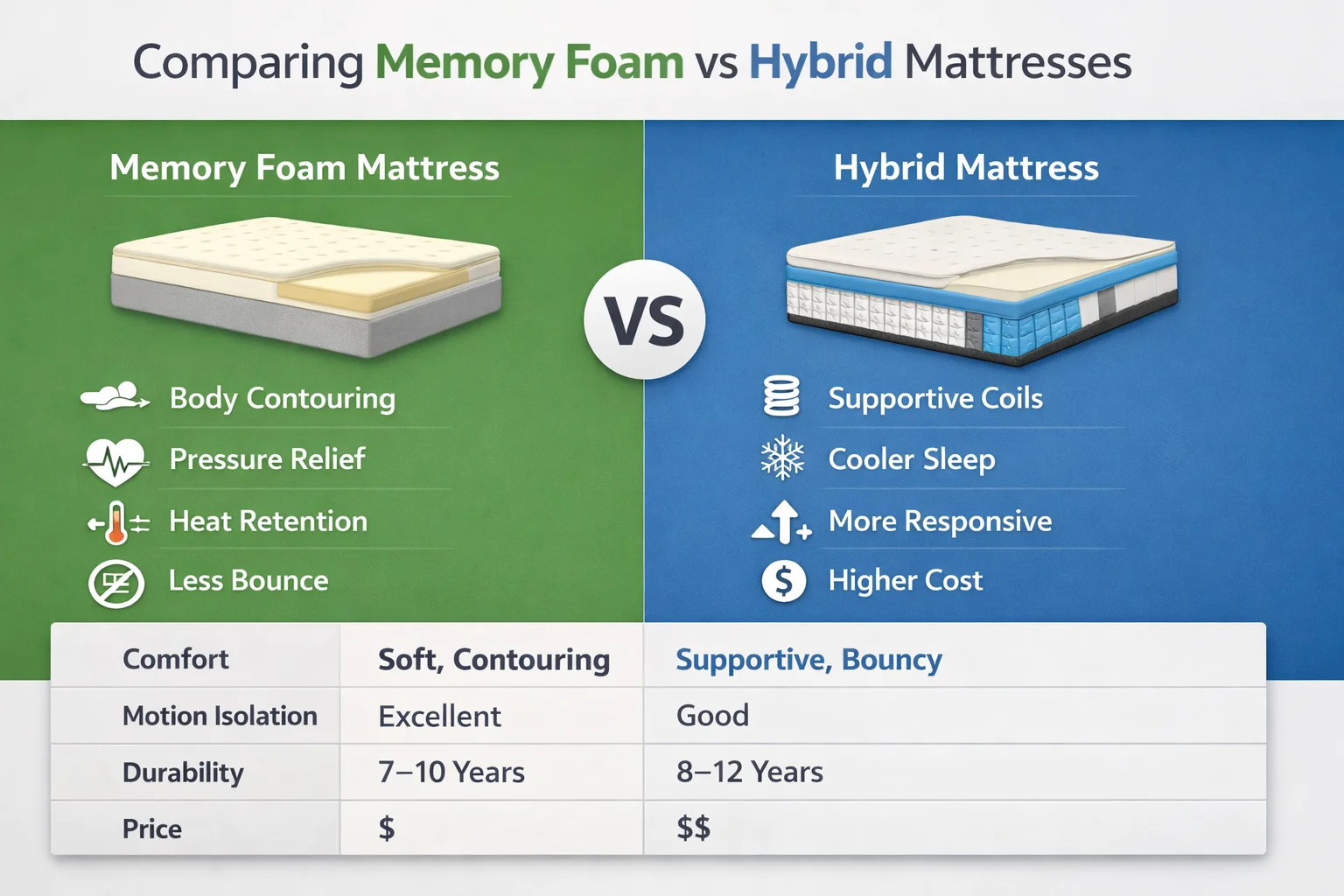
    When you make a table comparing memory foam vs hybrid mattresses, you see that each excels where the other typically struggles.

    Table 1: Technical & Performance Specifications

    Feature Memory Foam Mattress Hybrid Mattress
    Material Composition 100% Specialized Polyfoams Coils + Foam/Latex Layers
    Primary Sensation Deep contouring; “The Hug” Responsive lift; “The Bounce”
    Cooling Efficiency Moderate (traps heat unless gel-infused) High (natural airflow through coils)
    Motion Isolation Exceptional (Zero disturbance) Good (Coils add slight energy)
    Edge Support Low to Moderate (Edges sink) Superior (Reinforced perimeter)
    Response Time Slow (takes seconds to recover) Instant (moves with you)
    Durability 7–10 years 8–12+ years
    Weight Lighter; easier to rotate Heavier; requires two people to move

    The Science of Sleep: Temperature and Breathability

    One of the most significant factors in 2026 mattress technology is thermoregulation. Our bodies must drop 1–2 degrees in temperature to enter deep REM sleep.

    • Memory Foam’s Struggle: By design, memory foam needs heat to contour. This proximity traps a layer of warm air between your skin and the foam. In 2026, manufacturers use “Phase Change Materials” (PCM) and copper infusions to draw heat away, but the material is still fundamentally dense.

    • The Hybrid Solution: Because a hybrid is mostly air (the space between the coils), it acts as a giant bellows. Every time you move, hot air is pushed out of the mattress and cool air is pulled in. If you wake up sweaty, a hybrid is almost non-negotiable.

    Support for Your Body Type and Position

    Your physical build is the ultimate “filter” when you make a table comparing memory foam vs hybrid mattresses.

    Hybrid Mattress

    Body Weight Considerations

    • Light Sleepers (<130 lbs): You may find hybrids too “stiff.” Because you don’t have the weight to compress the heavy-duty coils, you essentially stay on the very top, which can feel like sleeping on a board. Memory foam is often better here as it responds to your heat regardless of weight.

    • Heavier Sleepers (>230 lbs): An all-foam mattress is risky. Over time, the foam can “bottom out,” leaving your spine unsupported. Hybrids are engineered for this; the steel coils provide a structural “floor” that foam cannot provide.

    Sleeping Positions

    • Side Sleepers: Need deep pressure relief for shoulders and hips. Memory foam is the gold standard here because it allows these “pointy” parts of the body to sink in while filling the gap at the waist.

    • Back Sleepers: Require a balance. You need your hips to sink slightly, but not so much that your spine bows. A hybrid with “zoned support” (firmer coils in the center) is the ideal 2026 solution.

    • Stomach Sleepers: This is the most dangerous position for back pain. If your hips sink too deep (as they often do in memory foam), your lower back arches painfully. A firm hybrid provides the necessary upward tension to keep your body flat.

    The Evolution of 2026 Trends: Smart & Sustainable

    The “mattress in a box” revolution of the 2010s has evolved into the “Smart Bed” era of 2026.

    1. Smart Sensors: Many 2026 hybrids now feature “biometric arrays” embedded between the foam and coils. These track your heart rate, respiratory rate, and sleep stages without requiring a wearable device.

    2. Eco-Friendly Composites: We are seeing a move away from petroleum-based foams. Both memory foam and hybrid manufacturers are now using “bio-foams” derived from soy or castor beans, and recycled steel for the coil units.

    3. Adjustable Firmness: Some high-end hybrids now allow you to swap out internal foam “cassettes” to change the bed from soft to firm as your needs change over the years.

    Real-World Practicality: Edge Support and Motion

    If you share your bed, these two factors become your primary concerns.

    Motion Isolation: The Silent Partner

    Memory foam is the undisputed king of motion isolation. If you make a table comparing memory foam vs hybrid mattresses for a couple where one person is a “toss-and-turner,” memory foam wins every time. It absorbs energy rather than reflecting it. In a hybrid, even with pocketed coils, the steel still has a “kinetic memory” that can carry vibration to the other side of the bed.

    Edge Support: The Perimeter Problem

    Have you ever sat on the edge of your bed to tie your shoes and felt like you were sliding onto the floor? That is a lack of edge support. Memory foam is soft all the way to the edge. Hybrids solve this by using higher-gauge (thicker) steel coils around the perimeter. This effectively increases the usable sleep surface of the bed—critical if you share a Queen-sized mattress and don’t want to feel like you’re falling off.

    Durability and Long-Term Value

    A mattress is an investment in your productivity and health. While hybrids are generally more expensive ($1,200–$3,000) than memory foam ($800–$2,500), they often have a lower “cost per year.”

    • Foam Fatigue: Memory foam is subject to “oxidation” and cell breakdown. After 7 years, the foam may still look fine, but its “recovery” time slows down, leading to permanent dips.

    • Coil Resilience: Steel does not oxidize like foam. A high-quality tempered steel coil can maintain its bounce for over a decade. In 2026, most luxury hybrids are rated for 12+ years of consistent support.

    Table 2: Recommendation Matrix

    If You Value… Your Winner Is… Why?
    Silence Memory Foam No moving parts; no squeaking.
    Cooling Hybrid 30% more airflow via the coil core.
    Ease of Moving Hybrid The “bounce” helps you roll over effortlessly.
    Budget Memory Foam Simpler manufacturing leads to lower retail costs.
    Spinal Alignment Hybrid Zoned coils provide targeted support for the lower back.
    Joint Pain Relief Memory Foam Unrivaled “cradling” of pressure points.

    Conclusion: Which Technology Wins?

    In the battle to make a table comparing memory foam vs hybrid mattresses, there is no objective loser—only a better fit for your specific biology.

    Choose a Memory Foam mattress if: You are a side sleeper who prioritizes a quiet, motion-free environment, and you love the sensation of being completely cradled. It is the ultimate “stress-relief” material that allows you to feel weightless.

    Choose a Hybrid mattress if: You are a hot sleeper, a back/stomach sleeper, or an individual who weighs over 200 lbs. The hybrid offers the structural integrity and breathability required for long-term health and temperature neutrality.

    By 2026 standards, the hybrid is arguably the more “versatile” choice for the average person, but memory foam remains the gold standard for pure, unadulterated comfort. Weigh your needs against the tables provided, and you will find the sleep surface that transforms your nights.

  • how to be confident : A Practical Guide Without False Promises

    how to be confident : A Practical Guide Without False Promises

    We have been sold a lie about what it means to be self-assured. We are told it is a lightning bolt that strikes some people at birth, or a “hack” that can be unlocked by shouting affirmations at a bathroom mirror. We are told to “fake it until we make it,” as if the world won’t notice the tremors in our voice if we just wear a louder suit.

    The reason most people struggle with how to be confident is that they are waiting to feel brave before they start acting. They treat confidence as a prerequisite for action, when in reality, it is the byproduct of it. This disconnect is why traditional motivational advice fails: it focuses on the internal state (how you feel) rather than the external evidence (what you have done).

    True confidence isn’t the absence of fear or the presence of bravado. It is the quiet, grounded knowledge that you can handle a situation, regardless of the outcome.

    Defining the Terms: Confidence vs. Arrogance vs. Self-Esteem

    To build a solid foundation, we must first define what we are actually building. In common parlance, these three terms are often used interchangeably, but they represent very different psychological foundations.

    Confidence

    Confidence is situational competence. It is the belief in your ability to succeed at a specific task. You might be highly confident in your ability to drive a car but have zero confidence in your ability to perform heart surgery. It is rooted in reality and evidence.

    Arrogance

    Arrogance is a defensive mechanism. It is an exaggerated sense of one’s own importance or abilities, often used to mask a deep-seated insecurity. While confidence says, “I am capable,” arrogance says, “I am better than you.” Arrogance requires an audience to validate it; learning how to be confident allows you to be comfortable in silence.

    how to be confident

    Self-Esteem

    Self-esteem is your overall sense of self-worth. It is the baseline of how much you like and respect yourself as a human being. While you can have low confidence in a specific skill (like public speaking) but still have high self-esteem, a complete lack of confidence across many areas often begins to erode self-esteem over time.

    Why We Lack Confidence: The Internal Barriers

    If confidence is a natural byproduct of growth, why do so many of us feel stuck in a state of perpetual doubt? The barriers are rarely a lack of “talent.” Instead, they are psychological anchors that keep us tethered to our comfort zones.

    • Fear of Judgment: We are social creatures. Evolutionarily, being cast out of the “tribe” meant death. Today, that instinct manifests as a paralyzing fear of looking stupid.

    • The Comparison Trap: In the digital age, we compare our “behind-the-scenes” footage with everyone else’s “highlight reel.

    • The Weight of Past Failures: Many people carry a “failure resume” in their heads. One bad experience becomes a permanent label: “I’m not good at this.

    • The Competence Gap: Sometimes, you feel unconfident because you aren’t skilled yet. This isn’t a character flaw; it’s a data point.

    The Core Principle: Action Over Affirmation

    If you take nothing else from this guide, remember this: Confidence is a lagging indicator.

    You cannot think your way into a new way of being. If you sit on your couch trying to convince yourself you are a great public speaker without ever standing behind a podium, your brain will reject the thought because it has no evidence to support it. The brain is a sophisticated lie detector. It requires “proof of work.

    Confidence grows through developing competence. When you do a difficult thing and survive, your brain updates its internal map. It says, “Oh, we did that, and we didn’t die. Maybe we can do it again.

    Practical, Research-Based Strategies

    Building a strong presence is a manual process. It requires a blue-collar approach to your own psychology. Here is how to be confident through the foundation of skill-building.

    1. The Strategy of “Small Wins”

    The fastest way to build confidence is to set a small, manageable goal and achieve it. These are “micro-promises” to yourself. If you promise yourself you will walk for ten minutes and you actually do it, you build trust with yourself.

    Action: Choose a skill you want to develop. Break it down into the smallest possible unit. Don’t try to “be a writer”; try to write 50 words today.

    2. Radical Skill Development

    Confidence is often just the outward expression of competence. If you feel insecure at work, it might be because you haven’t mastered the tools of your trade. Instead of trying to “feel” more secure, spend three months developing competence through mastery of your subject matter. When you know your subject matter deeply, confidence is the natural result.

    3. Improving Body Language (The Feedback Loop)

    While “power posing” has been debated, the link between physiology and psychology is undeniable. Slumping and avoiding eye contact sends a signal to your brain that you are under threat.

    • The “Open Frame”: Keep your shoulders back and your chest open.

    • Eye Contact: Practice holding eye contact for one second longer than is comfortable. These aren’t tricks to fool others; they are signals to your own nervous system that you are safe.

    4. Reframing Failure as Data

    Confident people do not view failure as a reflection of their identity. They view it as a diagnostic tool. Learning how to be confident means externalizing failure so you can protect your self-esteem while maintaining the ability to improve.

    5. Curating Your Environment

    If you are surrounded by people who constantly belittle your ambitions or highlight your flaws, understanding how to be confident is like trying to grow a fire in a rainstorm. You need a “supportive environment” of people who hold you to a high standard and encourage your growth.

    Realistic Scenarios: The Path of Progression

    Consider the example of Sarah, a junior software engineer who was terrified of speaking up in meetings. She focused on taking action despite fear rather than waiting for the fear to vanish.

    She didn’t wake up one day and deliver a keynote. Instead, she followed a realistic progression:

    1. Week 1: She committed to asking one clarifying question in a small team meeting.

    2. Week 3: She volunteered to provide a two-minute update on her specific task.

    3. Month 2: She noticed a bug and proposed a solution in front of the senior lead.

    4. Month 6: She led a 20-minute presentation.

    Sarah’s journey shows how to be confident through a series of increasingly difficult challenges. She allowed herself to be “clunky” and nervous in the beginning.

    Debunking the Myths of the “Natural”

    We often look at charismatic leaders and assume they were born with a “confidence gene.” This is almost never true.

    Myth 1: “Confident people aren’t afraid.”

    The truth is that confident people feel the same physical symptoms of anxiety—racing heart, sweaty palms—as everyone else. The difference is their interpretation. They interpret those signals as “excitement” or “readiness.”

    Myth 2: “You must be 100% sure of yourself.”

    Confidence is not certainty. Real confidence is being 60% sure you can do it, and 100% sure you can handle it if you fail.

    Myth 3: “Confidence is a permanent state.”

    Confidence fluctuates. You can feel like a titan in your professional life and like a clumsy teenager in a new dance class. This is normal.

    The Discipline of Self-Talk

    While “positive thinking” is often overhyped, negative self-talk is a genuine deconstructor of confidence. Many of us speak to ourselves in ways we would never speak to a friend.

    If your internal monologue is a constant stream of “You’re going to mess this up,” it creates a cognitive load that makes failure more likely. Part of how to build real confidence is moving away from self-criticism toward neutrality.

    Instead of “I’m going to ruin this presentation,” try: “I have prepared for this, and I am going to deliver the information I have.” Stick to the facts.

    Conclusion: The Long Road to a Solid Self

    Real confidence is not a flashy, immediate transformation. It is a slow-motion construction project. It is built in the quiet moments when you choose to do the work instead of checking your phone, when you choose to have the difficult conversation instead of staying silent, and when you choose to get back up after a public mistake.

    There are no shortcuts to how to be confident. You cannot bypass the “awkward phase” of learning a new skill. You cannot avoid the discomfort of growth. But if you focus on developing competence, taking action despite fear, and being honest with yourself about your progress, confidence will arrive unbidden.

    Stop waiting for the feeling. Start with the action. The feeling will catch up when it sees the proof.