Author: Hiren Bhuriya

  • Analog Journaling: Why It Works, How to Start, and How It Changes Your Brain

    Analog Journaling: Why It Works, How to Start, and How It Changes Your Brain

    Key Takeaways:

    • Analog journaling leads to more profound cognitive processing and memory encoding that are often not reflected by typing.
    • Writing your feelings on a paper helps your mental health: it lowers stress, reduces the symptoms of depression, and can even improve the immune system.
    • The simple journaling habit (daily or weekly) with prompts and physical routines can be a fast way of achieving permanent mental clarity and emotional growth.

    What Is Analog Journaling?

    In the time of screens, analog journaling is a conscious writing-by-hand-in-the-notebook practice — be it daily reflections, morning pages, habit logs, or free writing. People do analog journaling not only for the sake of the past, but also because the physical writing seems to go to those parts of the brain which cannot be reached by typing.

    This article is for you if you want to know the working mechanism of analog journaling, need research-based reasons to try it, and require a life integration plan as your next step.

    Also Read: What Is a Junk Journal & Why It Might Be the Most Powerful Self-Care Tool You’re Missing

    The Brain & Body Benefits of Handwriting

    1. Memory & Deeper Processing

    The study by Pam Mueller and Daniel Oppenheimer, “The Pen Is Mightier Than the Keyboard,” in 2014, shows that students who wrote their notes by hand were able to answer conceptual questions much better than those who typed their notes.

    They suggest that typing allows one to copy almost word for word but writing by hand requires one to summarize, rephrase, and thus, mentally interact with the content.

    More experiments comparing handwriting and typing also indicate that writing by hand involves those areas of the brain that are related to learning and memory more than when one is typing.

    1. Expressive Writing & Mental Health

    One of the most striking findings from James Pennebaker’s research on expressive writing is that people who write for 15-20 minutes about their most emotional, stressful, or traumatic experiences, 3-5 times, see psychological and physical improvements.

    In a meta-analysis and subsequent study, expressive writing is associated with alleviation of depressive symptoms, diminished anxiety, and enhanced immune system as measured by T-lymphocyte activity.

    Specifically, a clinical trial revealed that individuals suffering from Major Depressive Disorder who did expressive writing had statistically and clinically significant decreases in their depression scores that lasted for a month.

    1. Emotional Clarity & Regulation

    According to the Child Mind Institute, journaling techniques helps one to become more emotionally aware, practice self-reflection, and get rid of stress.

    A large number of users also share this view through their journals and blogs: many consider that writing in an analog journal helps them slow down the noise in their head and understand their inner emotional patterns.

    What Recent Research adds on the Journaling Ecosystem

    The 2025 qualitative study “Crafting a Personal Journaling Practice” interviewed people who keep analog journals and also analyzed journals on YouTube and Instagram. According to the authors, a “journaling ecosystem” consists of:

    a.) Material (what journal, pen, type of paper, etc.)

    b.) Personal context (when and why you are journaling)

    c.) Community (the influence sharing and seeing others journaling have on your practice)

    They claim that these elements not only determine the intensity of journaling but also the extent to which it contributes to personality growth and mental health.

    One quote:

    “Journalers develop strong personal preferences around the tools they use … understanding how analog journaling practices are individually shaped … is critical to supporting … improved mental health.”

    It is very important for us to understand this in order to be able to support

    My Personal Story When Analog Journaling Made the Difference

    A couple of years back, I decided to try the morning-page method: 10 minutes of writing as the first thing in the morning, before even looking at email or picking up the phone. After less than a week, I started noticing something unusual: I felt a lot more calm, with much less mental clutter, as if the writing was actually helping me to unload my thoughts from my head onto the page.

    One morning it dawned on me that I had been obsessing over a work-related argument all night long, and through my writing, I was forcing my brain to deal with it. After writing it down, I was able to sleep better and I woke up feeling fresh and clear-headed. That unexpected calm was really strong.

    How to Start an Analog Journaling Practice That Lasts

    Here’s a plan you can follow to build a sustainable, effective analog journaling habit:

    1. Choose Your Tools Wisely

    It is better to choose a notebook that gives you a comfortable feeling while holding. The paper texture is very important.

    Choose a pen that makes you happy. If the ink is not continuous or through the paper, you will oppose journaling.

    Optional: a ruler, sticky tabs, or colored pens for organization.

    2. Set a Routine

    You can journal either in the morning before electronic distractions take over your day or in the evening reflecting on your day before going to bed.

    Start with just 5 minutes/day or a single page, 3–4 times/week.

    If you are going through something deeper, commit to writing 15 minutes each session, focusing on emotional expressive writing.

    3. Use Prompts to Jumpstart Reflection

    Here are starter prompts:

    • “What’s on my mind right now?”
    • “What am I worried about today and why?”
    • “3 things I’m thankful for today.”
    • “What was my small win today?”

    4. Reflect Monthly

    Each month, go through all your journal pages again. See that? You have more and more common themes. Monthly reflection is a short piece of writing where you summarize the main themes appearing again and again from your pages.

    5. Combine with Digital Tools (Which is Optional)

    If you are fond of digital, why not go hybrid: writing on paper for your personal reflection and then logging bullet points or trends in digital journals for easy access. This way, you keep both the depth and the convenience.

    6. Deal with Common Barriers

    • Blank page fear → beginning with a prompt or stream-of-consciousness free writing for 2 minutes might help.
    • Feeling it’s pointless → just keep going; the benefits take their time to build.
    • Losing journals → monthly scanning or photographing of your pages can serve as your backup.

    Real-World Case Study: Expressive Writing to Support Depression

    A clinical trial enrolled people suffering from Major Depressive Disorder. The participants were divided into two groups. The experimental group was instructed to write for 20 minutes for 3 consecutive days by hand about their deep emotional events, while the control group wrote about non-emotional daily events. The group who did the expressive writing showed significant improvement in their depression scores not only right after the writing but also at the 4-week follow-up.

    This is an example of how a simple analog journaling tool can create a significant emotional impact and can even be helpful with serious depressive symptoms.

    Why Analog Journaling Still Wins Over Digital

    • When writing by hand, your brain is more involved: since it is done at a slower rate, there is more time for processing.
    • You are not as easily distracted. There are no notifications, open tabs, or clickbait to lure you.
    • The words you have written manually are more “yours” mentally.
    • Notebooks, being tangible, are like the physical evidence of your development – you can look back on them and see your advancement.

    However, digital platforms are excellent in terms of search, syncing, and analytics. A lot of people find it helpful to use both in conjunction i.e. journaling on paper and later writing down the summaries in digital form.

    Action Steps:

    1. First, get a journal and a pen that you’d like to use.
    2. Make a promise to yourself to spend 5 minutes writing every day, either in the morning or in the evening, for 21 days in a row.
    3. If you are undergoing emotional distress, add just one session of expressive writing for 15 minutes.

    It is important to keep going. A month later, come back again, and go through your journal pages.

    Check Out: How to Fix Shaky Hands in Photography

     

  • What Is a Junk Journal – Why It Might Be the Most Powerful Self

    What Is a Junk Journal – Why It Might Be the Most Powerful Self

    Key Takeaways: 

    • A junk journal is an artistically made book comprising personal and discarded items, mementos, and mixed media materials for memory-keeping, self-expression, and emotional processing. 
    • One of the benefits of making junk journals is that it supports mental health: creative art has been found to lower the stress hormone cortisol, diminish the feeling of stress, and, provide therapeutic “flow” states. 
    • There is no barrier to entry: basically, you only require some discarded materials, old tickets, glue, and tape and the willingness to put them together. The outcome is only a part of the story, the rest is the journey. 

    Essentially, a junk journal is a scrapbook that represents the person, in a physical way, created from ephemera – ticket stubs, letters, fabric pieces, dried flowers, magazines, receipts – stuff that you normally would have thrown away.

    But instead of throwing these things away, you transform them into albums that narrate your tale, both visually and emotionally. Purpose of a junk journal is frequently asked by a lot of people: what is a junk journal used for or what do you do with a junk journal?

    This article will explain how a junk journal functions, its rise in popularity, its role in mental wellness, and the step-by-step process of making your own. If you are looking for a creative way to deal with your memories or just to develop a self-care routine, then you have come to the right place.

    What is a Junk Journal? 

    A junk journal mostly represents the artistic elements of journaling, the creativity of scrapbooking and the picture way of storytelling of the collage into one beautiful art form. In general, junk journaling doesn’t depend much on the writing of the stories but rather on the use of found objects and mixed media from the different layers to express the stories. 

    They are not bought ones. You may choose already made books or even make your own binding with loose sheets of paper. After that, you start gathering your scraps such as receipt, ticket, note and wrapper and stick them on pages thus creating the visual layers that speak of the texture and also the meaning of the pages. 

    Why People Make Use of Junk Journals

    a.) Memory Keeping & Storytelling

    One function of junk journals is to act as time machines. A ticket for a concert you attended five years ago or a note that was written by hand can bring back to you that time very fast. 

    When things are put in drawers or boxes, they may become forgotten. However, when they are well arranged in a journal, they are still alive and are now your narrative’s characters. 

    b.) Mental Wellness & Emotional Processing 

    Any kind of art creation is good for one’s psychological wellbeing. Researches indicate that engagement in a creative activity for only 45 minutes can help relieve stress and result in a decrease of cortisol level. 

    The Frontiers research also reports that a 4-week art making program led to reduction in stress level as reported by the participants. 

    Part of this is junk journaling. The actual work of cutting, gluing and arranging helps the mind to let go of the stressful thoughts and enter the flow state: that complete focus on the here and now, where time seems to be changed. 

    c.) Self-Expression & Healing 

    There are times when words are not sufficient. Through junk journaling, an individual is allowed to express his or her emotions with the help of the visuals like textures, layers, and found objects. In a situation where you cannot give a certain feeling a verbal form, the process of composing a collage can be your expression. 

    d.) Mindfulness & Grounding 

    The work does so by involving all the senses of a person. Feeling the paper, smelling the old ink, using the glue and the scissor — all these sensory experiences put one in the here and now and evoke the feeling of calm. 

    e.) Community & Creative Connection 

    Junk journaling community extends beyond the physical pages of a journal. Members of community post their work online, share ideas, and attend workshops to meet and connect with other members. The shared creative process engagement, as a result, helps to overcome the feeling of loneliness.

    How to Build Your Own Junk Journal: Step-by-Step

    Here is how I did mine (a little story): I had a drawer jam-packed with ticket stubs from concerts, receipts, and postcards from trips. One night I took them out of the drawer, grabbed scissors and glue, and started turning them into pages of an old notebook. After only 10 minutes I noticed that I was unwinding profoundly – I had completely lost track of time. That was the moment when I knew I had to keep going. 

    Here’s the way to start: 

    1. Decide Your Theme or Purpose 

    What if you decided to turn it into a travel journal or simply a daily memory one? Or why not keep it open-ended? 

    1. Gather Materials 

    Root out your house for scraps. Do you have leftover fabric, ticket stubs, or maybe some old greeting cards? Don’t fret about perfection. 

    1. Choose Your Journal 

    Whatever notebook you have will do the trick. Or why not just tie pages together with string or ribbon? 

    1. Arrange & Glue 

    Just pick a base page to start with. Tear your paper, arrange your layers of fabrics, glue. Follow your instinct. 

    1. Add Writings/Thoughts 

    Remember to leave some blank spots to jot down your introspections, thoughts, poems. You may place your writings next to or on top of your collages. 

    1. Reflect & Review 

    Look back at the spreads you have made. Think about it: What memories are these calling? What feeling comes up? 

    1. Repeat Often 

    Junk journaling becomes really strong when one keeps it up regularly. Gradually, your journal turns into a pattern of your life. 

    Reddit Real-User Voice & Why It Matters 

    For me, the use of my junk journal is to have all my memorabilia in one spot… It’s much better than my last method of just throwing everything in a drawer.” 

    “The main reason why I do it is for creative expression … it liberates my space and at the same time, allows me to keep a ‘piece of junk’ in a productive … way!” 

    These testimonies indicate that for the majority of people, the point of creative release is not to achieve clarity, it serves as a form of memory consolidation and emotional container. The fact that the end product may be untidy is insignificant; what really matters is the act itself. 

    Conclusion & What You Should Do Next 

    What junk journals really are extends beyond being simply attractive books. They function as an interconnection between memory, creativity, and emotional well-being. Whether you decide to make one to save your scraps, alleviate your stress, or dive into your inner world, chances are that the journey will be therapeutic. 

    Next Steps: 

    1. Use a journal or notebook that you already have. 
    2. Find 5 pieces of ephemera: an old ticket stub, fabric, paper, or anything else. 
    3. Initiate a one-page journal spread tonight — no pressure. 
    4. After a week, ask yourself: ‘How did the process make me feel mentally’?

    Also Check Out: Luxury Vacation Rental Guidebook Criteria


  • Top Clear Signs You Should Talk to a Mental Health Professional Today

    Top Clear Signs You Should Talk to a Mental Health Professional Today

    Everybody has stressful, depressing, or anxious moments, but when they persist or get worse, they can start to interfere with day-to-day functioning.  Persistent worry, negative self-talk, or even hopelessness that you can’t seem to get rid of are all examples of unwanted thoughts and feelings.

     Although it’s normal to question whether your problems are “serious enough” to warrant seeking assistance, speaking with a mental health expert can have a significant impact long before obstacles become too much to handle.

     The warning signs, the advantages of early intervention, and how to determine when it’s time to take that crucial step toward assistance and recovery are all covered in this guide.

    What Are Unwelcome Thoughts and Emotions?

    Intruding images or ideas that you can’t ignore, constant concern, profound grief, numbness, or overwhelming guilt or shame that doesn’t seem to go away are examples of unwanted thoughts and feelings. They aren’t always spectacular or extreme; they can also manifest as a silent, ongoing drain, such as feeling distant from the people you care about, waking up nervous for no apparent reason, or repeatedly repeating a mistake.

    It’s critical to keep in mind that having occasional bad emotions is a natural component of being human. It’s common to have anxiety before a huge shift, grief after a loss, or stress before a job interview.

    Why People Hesitate to Seek Help

    Many people put off seeking assistance because they feel ashamed, afraid of being judged, or think their issue isn’t “serious enough.”  You may convince yourself that you can handle things on your own or fear that treatment will stigmatize you.  Access, time, and expense are examples of practical obstacles.

     The comforting reality is that asking for assistance is a sign of clarity rather than weakness.  Getting mental health care is like going to the doctor for a chronic cough.  In many cases, problems are easier to treat the earlier they are addressed.

    The next section outlines the specific warning signs that indicate it’s time to consult a professional, so if you’re unsure whether to get in touch, keep reading.

    Signs It May Be Time to Talk to a Mental Health Professional

    1. Your feelings seem excessively intense or persistent:

    Anger, irritability, depression, or worry that doesn’t go away with time or relaxation and persists for weeks (more than two weeks) is a warning sign. You can’t “tough out” persistently overwhelming emotions.

    1. Repetitive or upsetting ideas are undesirable:

    This includes uncontrollable intrusive thoughts, such as visions, uncertainties, or anxieties that arise and cause you distress. It’s time to get help if they cause you to feel ashamed, interfere with your ability to concentrate, or disturb your sleep.

    1. Everyday life begins to suffer:

    Professional support can assist in reestablishing equilibrium when mental or emotional challenges make it more difficult to concentrate at work, fulfill obligations, or preserve relationships. A persistent drop in performance or social disengagement is cause for concern.

    1. You feel despair or consider harming yourself:

    If unwelcome ideas involve self-harm or a deep sense of hopelessness, it’s imperative to seek help immediately.  These crises are urgent signs that you need care, and professionals are equipped to help you through them.

    1. You’re no longer motivated or interested:

    Physical symptoms are frequently a sign of mental health problems.  Prolonged emotional stress may manifest as sleep problems, exhaustion, changes in appetite, frequent headaches, or unexplained symptoms.

    1. Your feelings seem very strong or persistent:

    It can be more than just a brief dip if unwanted thoughts or feelings persist for longer than 1.5 weeks without alleviation.  Anxiety, irritation, or persistent depression that doesn’t go away on its own is a clear indication that you need professional help.

    1. You’re staying away from People & events:

    Avoidance is a typical coping mechanism that can easily become restrictive. A therapist can assist you in addressing the underlying cause if you find yourself avoiding relationships, work-related activities, or events in order to cope with worry or unwelcome thoughts.

    What Happens When You Talk to a Mental Health Professional

    Mental Health Professional

    The first step in speaking with a mental health professional is typically to have a talk in a private, secure setting about your experiences and how they have affected you.

    Before seeking help, many people wait until they are completely overwhelmed, despite the fact that early intervention is one of the best things you can do for your mental health. So depressing!

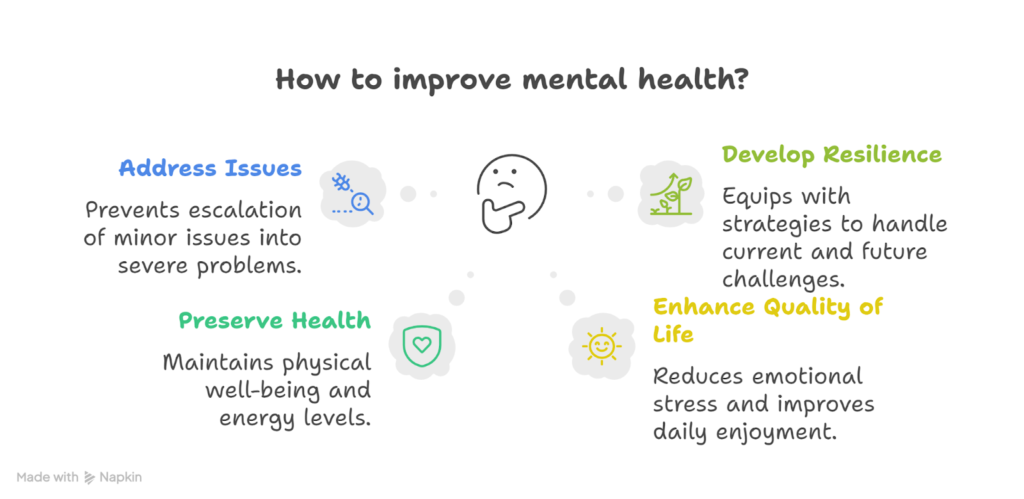
    Early intervention for unwanted thoughts and feelings can:

    • Avoid the intensity or seriousness of something bad such as conflict or tension: Ignoring minor issues might lead to more severe mental health issues.
    • Preserve general health: The immune system, energy levels, and physical health are all impacted by mental health.
    • Enhance quality of life: Receiving help early on frees you from ongoing emotional stress so you may enjoy relationships, your job, and everyday activities.
    • Develop resilience: Counseling and therapy offer strategies and resources that help you deal with present issues while also becoming ready for new ones.

    Advantages of Consulting a Mental Health Expert

    Although speaking with a mental health professional can seem like a major step, there are many advantages that go beyond simply feeling better.

    1. Understanding Your Symptoms

    First of all, you can gain crucial insight into your mental health symptoms by consulting with a mental health counselor.  You probably know you’re experiencing a mental health issue if you’ve been feeling unwell and finding it difficult to interact with others. 

    You may not be fully aware of what is happening, though.  You can get more information about your symptoms by speaking with a mental health counselor.

    This can occasionally result in a useful diagnosis, and other times it can help you better understand your feelings and how to deal with them.  Regardless of the severity or duration of your mental health crisis, being clear about what happened will help you identify

    1. Better Interaction

    Second, you will be able to communicate your mental health condition to others more effectively if you consult with a mental health counselor.

    Regular sessions with a mental health counselor will help you get used to discussing your emotions, symptoms, and challenges in a more relaxed and targeted manner.This will thus make it easier for you to discuss your mental health with individuals in your immediate vicinity.

    This is crucial because your closest friends and family members are frequently the ones who can support you during your darkest hours. But they won’t know how to support you if you never let them know what you’re going through.

    1. Increase  hope & Confidence

    You can feel more optimistic about your mental health by scheduling a consultation with a mental health counselor. It can be hard to think that you’ll ever feel better while you’re experiencing a mental health crisis.

    You may believe that your anxiety or depression symptoms will never go away.However, you will discover how to fight your symptoms and achieve healing once you begin seeing a mental health specialist. You’ll begin to see the future with greater optimism.

    How to Take the First Step

    Being willing is all that is needed to take that initial step; perfection is not. Write down your observations, including symptoms, duration, and instances of how they affect your life. Your initial appointment will be more targeted if you have this journal or symptom list.

    Ask your primary care physician for a recommendation, look out registered therapists online (verify their qualifications and areas of expertise), look into telemedicine platforms for more flexible possibilities, or get in touch with community mental health facilities. To gain a sense of fit and style, many therapists provide brief phone sessions.

    Inquire about sliding-scale pricing, insurance coverage, or local resources if money is an issue. Keep in mind that early support frequently speeds up recovery, so you don’t need to wait until things get worse. And once more, contact emergency services or your local crisis hotline right away if you ever feel uncomfortable or overwhelmed by thoughts of harming yourself.

    Conclusion
    Unwanted feelings and thoughts are a natural part of being human, but when they persist, get worse, or start to get in the way of your life, it’s obvious that getting expert help could help. Early support can help you develop better coping mechanisms, stop minor issues from getting worse, and eventually enhance your relationships and general well-being.

    It’s not necessary to wait until things become intolerable before acting. Speaking with a mental health professional is a step toward recovery, resiliency, and leading a more complete, well-rounded life—it is not a show of weakness.

    read more- Free Things to Get on Your Birthday

  • What Lifestyle Choices Can Help Reduce the Risk of Suicide

    What Lifestyle Choices Can Help Reduce the Risk of Suicide

    Suicide is not an easy topic to talk about, but it’s something that affects so many peoples ,directly or indirectly because everyone faces this thought throughout their life. When someone is directly in that dark place, it’s barely about one single reason because behind their minds a lot of thinking runs. It’s often a mix of stress, loneliness, past trauma, or even small things that pile up over time.

    Good news is that there are some real lifestyle choices that can help lower the risk. They don’t replace therapy or professional help, but they can make a big difference in your life. It builds stronger mental health and emotional balance.

    Let’s talk about a few of them in a real and simple way.


    1. Building Strong Connections

    One of the biggest factors to thinking about suicidial is having people around who care. It doesn’t need to be a big crowd or even one or two best friends can make a huge difference.

    Try to connect with friends, talk openly and don’t isolate yourself. Loneliness feeds negative thoughts, and connection helps quiet them down.Sometimes, even a small talk over coffee or a phone call with your best friends or close one you trust can change how you feel for the day.

    If you know someone who’s struggling, don’t wait for them to reach out. Be the one to send a message or drop by because he or she needs your rings.


    2. Staying Physically Active

    It sounds simple, but exercise helps more than the people expected.
    Exercise your body ,even walking 20 minutes a day – releases chemicals like endorphins and serotonin that lift mood and reduce stress.

    You don’t need to go to the gym or run. You can dance in your room, go for walks with your dog, garden, ride a bike, do yoga – anything that your body can do .

    When your body feels stronger, your mind slowly starts to follow.


    3. Eating for Mental Health

    Food is one of the ways to change your mood. When we skip meals or live on sugar and caffeine, our energy spikes and crashes and that can make emotions harder to manage.

     Lifestyle Choices

    Try to eat balanced meals in your daily routine:

    • Whole grains, fruits, veggies, and lean protein.
    • Omega-3 fats (from fish, nuts, seeds) — they support brain health.
    • Drink water. Seriously, dehydration makes anxiety worse.
      You don’t have to eat “perfect.” Just add small healthy choices, one at a time.

    4. Good Sleep Habit

    Lack of sleep changes how the brain works.It can make sadness feel heavier, and problems seem bigger.

    Try to:

    • Go to bed and wake up around the same time.
    • Avoid too much screen time before bed.
    • Keep your bedroom calm and dark.

    Most adults need 7–9 hours of sleep, but most of the time adults sleep less than expected. Even small improvements can make a real difference in mental health.

    5. Learning to Manage Stress

    We all face stress-work, family, money, life. But when it builds up and doesn’t get managed, it can lead to stress.

    Simple ways to manage stress include:

    You can’t control everything, but you can control how you respond.

    6. Avoiding Alcohol and Drugs

    Alcohol or drugs might not be good for health, but they make things worse in the long run.They mess with brain chemistry, increase impulsivity, and often make sadness or anxiety stronger the next day.

    If it’s hard to stop alone, reach out for support or consult the Dr to quit alcohol. There’s no shame in asking for help.

    7. Creating a Daily Routine

    When life feels chaotic, structure helps. Having a simple daily routine gives the brain a sense of control.Wake up, make your bed, eat breakfast, go for a walk — these small habits may not seem like much, but they ground you.
    It gives your mind something steady to hold onto, especially on bad days.

    8. Finding Purpose or Meaning

    Having a purpose doesn’t mean you need a big life goal. It can be small like taking care of a pet, volunteering, helping others, or working towards your dream.

    Purpose reminds you that you matter and that your presence adds value to the world.It’s easier to keep moving when you know someone or someone needs you.

    9. Limiting Negative Influences

    What you see, hear, and scroll through every day affects how you feel.
    Too much news, toxic social media, or negative people can quietly wear you down.

    Try organizing your space: follow accounts that inspire you, remove the ones that don’t fit you. Spend less time comparing your life to others. Real life is not as perfect as it looks online.

    10. Seeking Professional Help

    Lifestyle change means to replace therapy or medical support when it’s needed.Talking to a mental health professional, a therapist, counselor helps you understand your thoughts better and learn healthy coping strategies.

    In the U.S., you can call or text 988 to reach the Suicide and Crisis Lifeline anytime, 24/7.You’re not alone, and asking for help is not weakness. It’s courage.

    Final Thoughts

    You don’t have to fix everything overnight.Reducing the risk of suicide is about small steps eating better, sleeping better, connecting, talking, moving, and asking for help when you need it.Life can get heavy, but it can also get better .one healthy habit at a time.The key is to keep showing up, keep choosing life, even on the hard days.

  • I Am the Way, the Truth, and the Life: What Jesus Really Meant

    I Am the Way, the Truth, and the Life: What Jesus Really Meant

    In John 14:6, Jesus makes one of the most powerful and exclusive statements in all of Scripture:

    “I am the way the truth and the life. No one comes to the Father except through me.”

    These words are not just theological — they are deeply personal. Jesus wasn’t speaking to the crowds here; He was talking to His closest followers during one of the most emotional moments of His life. Soon, He would be arrested, tried, and crucified. His disciples were confused, frightened, and uncertain about what was happening.

    When Thomas asked, “Lord, where are you going?” Jesus answered with this profound declaration — pointing them back to Himself. In doing so, He revealed not only who He is, but also what it means to truly live.

    Understanding the Context of John 14:6

    Before His crucifixion, Jesus was preparing His disciples for His departure. They didn’t yet understand that the path He was taking — the way of the cross — was necessary for their salvation. His response wasn’t a complicated theological explanation; it was an invitation to trust.

    By saying, “I am the way, the truth, and the life,” Jesus was telling them that everything they were searching for — direction, meaning, and eternal hope — could only be found in Him.

    “I Am”: The Name of Power and Authority

    The first words — “I am” — are significant. All throughout Scripture, “I AM” is the divine name God used for Himself when He revealed His identity to Moses (Exodus 3:14).

    By using this same phrase, Jesus wasn’t just describing Himself — He was declaring His divinity. He was saying, “I am God.”
    The religious leaders of His time understood this clearly, which is why they often accused Him of blasphemy.

    So when Jesus says “I am the way,” He’s not offering advice or pointing toward a path — He’s declaring that He is the path. The source of all life, truth, and salvation.

    Jesus Is the Way

    Notice that Jesus didn’t say, “I am a way.” He said, “I am the way.”
    This is an exclusive claim. It means there are not many routes to God or multiple versions of truth. There is only one — through Jesus.

    He is not one of many good options; He is the only way to eternal life.
    Every other path that promises fulfillment apart from Him ultimately leads to emptiness.

    Jesus Is the Truth

    Jesus continues, saying, “I am the truth.”

    He’s not saying He has truth — He is the truth itself. In a world full of competing voices, philosophies, and “personal truths,” Jesus stands as the final authority on what is real and eternal.

    Every belief and decision in our lives should be measured against His Word. If we want clarity and direction, we have to anchor our understanding of truth in Him.

    Jesus Is the Life

    Finally, Jesus declares, “I am the life.”
    He’s not simply the source of physical existence; He is the giver of spiritual life — the kind that fills the soul with peace, joy, and purpose.

    To know Jesus is to know life as it was meant to be lived — full, abundant, and eternal.

    Outside of Him, we may exist, but we aren’t truly alive.

    No One Comes to the Father Except Through Me

    This closing line makes His claim unmistakably clear.
    Salvation, forgiveness, and eternal life are found only through Jesus.

    That might sound exclusive, but it’s actually deeply loving.
    If there truly is only one way to God, the most loving thing Jesus could do is make that way clear — and He did. He invites us, just as He invited His disciples, to follow Him.

    3 Reflective Questions to Apply John 14:6 to Your Life

    This verse is not just something to understand — it’s something to live.
    Here are three questions to help you apply its truth to your daily walk:

    1. What direction is my life heading?

    Are you moving toward Jesus, or away from Him?
    Many people drift through life without thinking about where they’re going. Jesus offers a life filled with love, joy, peace, patience, kindness, and purpose — but we only find it when we follow His direction.

    2. Where do I get my truth from?

    We live in a world filled with countless voices claiming to know the truth. But are those voices leading you closer to Christ — or farther away?
    Jesus is the ultimate truth. Real freedom comes from aligning our beliefs and values with His Word.

    3. What do I believe I need to have a good life?

    Be honest here. What are you chasing — success, approval, comfort, or control?
    Often, we think we need “Jesus plus something else” to be happy. But chasing anything apart from Him eventually leaves us empty. True life and joy are found in Jesus alone.

    Finding True Life in Jesus

    When Jesus said, “I am the way, the truth, and the life,” He wasn’t offering a set of rules, He was offering Himself.
    He invites us to trust Him completely, to find our direction in His way, our certainty in His truth, and our fulfillment in His life.If you’re searching for purpose or peace, go to Him.
    Because in Jesus, you’ll find everything your soul has been longing for — the way, the truth, and the life.

    Read more- https://dev.journalingtechniques.org/journaling-techniques/

  • What Does Mary on a Cross Mean?

    What Does Mary on a Cross Mean?

    Ghost’s Tobias Forge has always had a talent for fusing the most exquisite musical touches with obscene lyrical imagery. He was the only one who could make his way into the mainstream of social media with a song that, on the surface, blended pop-rock hooks with sacrilege.

    This was demonstrated by Mary on a Cross’s song viral success. A slowed-down, reverb-heavy rendition of the three-year-old song was posted by a TikTok user in September 2022 to serve as the music for a collection of Stranger Things sequences. It quickly gained popularity, and over 300,000 TikTok videos utilizing the original or modified version of the song were created.

    Additionally, it was the band’s first entry into the US Billboard Hot 100 chart and went on to become their most listened-to song, now sitting pretty with over 210 million Spotify plays.

    Ghost, Context & Background

    The band’s own mythology states that Mary On A Cross began in 1969, when an early iteration of Ghost dipped its fingers in the decade’s psychotropic waves. Even if it was portrayed by a swaggering, attractive priest named Papa Nihil, this funky Ghost from the 1960s didn’t blow the world away.

    Only after Papa Nihil returned to the band in the twenty-first century and proclaimed himself Papa Emeritus Zero were Mary on a Cross and Kiss the Go-Goat dug up and reissued as the 2019 single Seven Inches Of Satanic Panic.

    The Swedish rock band Ghost’s 2019 album “Seven Inches of Satanic Panic” included the song “Mary on a Cross,” but it wasn’t until a bit later that it began to gain popularity. A slowed-down version of the song went viral on TikTok in 2022, and fans used it as the background music for many modifications of their favorite shows.

    What Does Mary on a Cross Mean?

    You could initially assume that the song is about Mary, the mother of Jesus. The song is not religious at all, but its chorus seems to allude to a sexual act by using religion in a completely other way.

    The chorus’s lyrics, “You go down just like Holy Mary, Mary on a, Mary on a cross,” are undoubtedly a reference to oral sex. The “real meaning” of the song is probably not that unexpected if you know anything about Ghost. According to The Independent, frontman Tobias Forge is basically a self-described modern Satanist, which makes the innuendo in the songs less alarming.

    Multiple Interpretations & Misunderstandings

    However, Tobias Forge has discussed the song, and it appears that it has been misunderstood. In an interview with Brann Dailor of Mastodon (via YouTube), Forge explained how his child’s buddy had heard that the lyrics to “Mary on a Cross” were “perverse,” which led Forge to elaborate on how the lyrics aren’t what they seem.

    “There are a few, there are multiple layers of the lyrics — it might be important for people to understand that,” Forge explained. “The chorus is written very tongue-in-cheek, of course. ‘Go down’ doesn’t necessarily mean as in a 69 sense of the word. It can also mean ‘go down’ as in ‘go down in history, your own ascent.’”

    According to Forge, the song alludes to individuals like Mary Magdalene whose motives have been misinterpreted. Nevertheless, as was indicated in the discussion above, the song has drawn a fair amount of criticism from people who find the lyrics insulting. In a subsequent Cutter’s RockCast broadcast, Forge addressed this matter once more, stating,

    “Of course, that is the backside of it, people hearing it and finding it, like, deeply offensive and this that or the other, just because they didn’t have the brain capacity to sort of realize what it is about.”

    The Band’s Lore and the Song’s Hidden Context

    It’s possible that Tobias Forge’s discussion of the “multiple layers of lyrics” with Brann Dailor alluded to the enduring narrative that Ghost incorporates into their songs.

    For those who are unfamiliar, TikToker @darkcodedarti shared a video that explains the history of “Mary on a Cross.” There are two people in the lore: Sister Imperator, who Planet Radio refers to as “the head of the Satanic clergy of Ghost,” and Papa Nihil, who is Forge’s alter ego. Sister Imperator was once a lover of Papa Nihil.

    The song was inspired by the imaginary couple’s reunion after they saw another music video called “Dance Macabre,” according to @darkcodedarti’s theory.

    Conclusion

    Mary on a Cross is still one of Ghost’s most popular and contentious songs; it’s an intriguing fusion of obscene imagery, unclear narrative, and emotional undertones. Even though Tobias Forge has made it clear that it is neither exclusively sexual nor exclusively spiritual, the fascination is nonetheless fueled by the multiple meanings and interwoven stories.

    Mary on a Cross demonstrates Ghost’s ability to make the sacred and profane dance together, solidifying their place in both rock history and contemporary online culture, regardless of whether it is seen as satire, storytelling, or spiritual metaphor.

    Read More- https://dev.journalingtechniques.org/blog/free-things-to-get-on-your-birthday/

  • 15 Journaling Techniques That Will Transform Your Life in 30 Days

    15 Journaling Techniques That Will Transform Your Life in 30 Days

    What is Journaling?

    Writing down your ideas, emotions, observations, or experiences is known as journaling. It can be a self-reflection exercise that gives you perspective and insight by allowing you to stand back from your life’s experiences and emotions.

    You can use journaling to document many aspects of your life, create goals, reflect, and get ready for the day. When I write things down, especially in long form rather than typing, I am better able to process them.

    It can perform a variety of functions and appear quite differently to various people at different stages of life. Is there a theme here? It is specific to you. You may write in your journal every day throughout certain seasons.You may only write once a week, twice a week, or once a month during other seasons. On some days, you may write for a short while, but on other days, you lose yourself in the writing.

    You can keep your journal totally secret if you’d like. Another option is to save it and give it to your kids and grandkids; this will depend on the kind of journal you have.

    15 Best Journaling Techniques That Actually Work

    Dream Journal

    One kind of diary that you might use to document and consider your dreams is a dream journal. You can record the specifics of your dreams in this kind of notebook, such as the persons, locations, and occasions you recall. Any related feelings or thoughts that arise during or after a dream are also recorded in a dream notebook.

    Gaining understanding of your subconscious and recognizing recurrent themes, patterns, and symbols are the objectives of maintaining a dream journal. Dream journaling can help you better understand your subconscious thoughts and feelings while seeing reoccurring patterns in your dreams. It can also be used as a tool for self-reflection, self-discovery, and self-improvement. Additionally, dream journals can help with lucid dreaming and dream recall.


    Goal Journaling

    I adore establishing goals, you know! But despite all of my goal-setting, I never thought of it as journaling. However, I came across other mentions of it when doing research for this article. Setting, monitoring, and commenting on your personal and professional objectives as well as their challenges are all part of goal journaling.

    It can be quite beneficial for self-motivation and accountability. Naturally, resources like the Powersheets from Cultivate, offer space to track your progress, reflection prompts, and goal rewriting. Any notebook can be used to record your goals, but I’ve discovered that I prefer having some structure and prompts to go to when I veer off course.

    Reflective Journaling

    When you think about journaling, you may think of reflective journaling.  It is the act of documenting and examining your feelings, ideas, and experiences.  Diving deeper into your daily thoughts and feelings, recollections, habits, values and beliefs, and goals and objectives is made easier with this kind of journaling.

    The details of your everyday life, such as your green smoothie for breakfast or the temperature of the air during your afternoon stroll, and how it affected you, don’t need to take up entire pages. That’s definitely an option, but you might also write about a difficult subject, make a list of positive things in your life, consider your religious practices, or investigate the reasons behind your reluctance to begin a new endeavor. Any reflection will do.

    Art Journaling Techniques

    A creative and personal notebook that incorporates aspects of visual art and writing is called an art journal. You can express yourself, explore your feelings and ideas, and try out different art mediums and techniques by keeping an art journal.

    An art journal includes visual components including drawings, paintings, collages, photographs, mixed media, and other artistic expressions, in contrast to traditional diaries that mostly concentrate on textual entries. Watercolors, acrylics, colored pencils, markers, pens, magazine cutouts, found objects, computer art, and even photographs can all be included in an art journal.

    Freewriting Journaling Techniques

    Freewriting, sometimes referred to as stream of consciousness writing, is just writing down your ideas, emotions, and anything else that comes to mind without editing yourself as you go. This kind of journaling, in contrast to other types, frequently includes speed-of-light scribbling, which helps to avoid pauses or any room for analysis.

    For those who prefer more mainstream journaling, writing about their day, reflecting on ideas and events, or answering certain questions might bring them serenity. Contrarily, freewriting requires you to write from the heart, without pretension or preparation. Creative authors frequently employ the technique of freewriting to get their ideas out and to write without worrying about grammar or punctuation, knowing that the rest can be done later.

    As someone who works with words for a career, I value the freedom to write down my deepest thoughts without feeling pressured to transform them into a story, stay on subject, give them structure, make them seem appealing to an audience that cannot see, or even make the words seem nice on paper. It’s a very freeing experience.

    In terms of journaling, establishing a comparable area for flow helps me process through my writing and occasionally uncovers treasures I otherwise would not have found. It’s also a great morning routine that gives you an opportunity to clear your mind before starting your day.

    Travel Journaling Techniques

    Simply said, a travel journal is a private log of your feelings, ideas, and experiences while traveling.  By recording your recollections of the locations you visit, the people you meet, and the adventures you have, travel journaling is a fantastic way to record and reflect on your travel experiences.

    Depending on your goals and tastes, there are several ways to keep a travel journal.  You have the option of starting a digital journal or blog or writing in a conventional notebook or sketchbook.  In addition to documenting their experiences, some people use their travel journals to plan their trip, keep tabs on their spending, and arrange crucial information like reservations, flight information, and contact data for locals they encounter while traveling.

    Food journals

    You can use a food journal as a tool to record your daily intake of food and beverages.

    Along with recording particular foods and drinks, you can also write down:

    How much food you ate, with whom you ate or by yourself, when and where you ate, and how you felt before, during, and after each meal or snack

    Doctors and nutritionists may advise keeping a food record in order to better understand your eating patterns. In certain situations, a medical practitioner will also use them to identify potential dietary or product sensitivities.

    Bible Journaling Technique

    Writing in your Bible is a visual religion activity known as Bible journaling  It might be as easy as underlining a verse and putting a comment or idea in the margin, or it can be as intricate as painting an entire page so that the words are visually reflected.  I find that keeping a Bible journal helps me concentrate when studying and retain the information I’ve read.  It can also make a lovely present for kids or grandkids.

    Prayer Journaling Techniques

    Writing your prayers in a notebook, like to a letter to the Lord, is a basic form of prayer journaling.  Alternatively, you may try visual prayer, which is the visual faith approach.  Adding a visual element to your prayers is the most basic form of visual prayer.  Using a pen or colored pencils and a sheet of paper, you can color while silently or loudly praying.  Simple.

     When I don’t want to share the prayer with anybody, I use an unlined notebook, but occasionally I do this on an index card or a 5 x 7 piece of paper that I can mail to the person I’m praying for. To break up the space in that situation, I just draw lines across the page. I then fill in each space with my requests for prayer. Once I’ve written a request, I’ll take out a colored pencil and use it to color the space while I pray over it. It’s an easy method to maintain concentration while praying and to visually record your requests.

    Daily Affirmation Journaling Techniques

    Every day I fight to become my own best friend and overcome my inner critic. Every day, I battle with my inner critic and try to be my own best friend. Before I give the day’s problems too much thought, I try writing down affirmations every day in my journal. It’s a means of adding compassion to my mornings.

    Affirmations every day When you’re feeling overwhelmed or mired in the past, journaling might help you retrain your brain and find peace. As they were for me, this collection of daily affirmations may help others who are experiencing PTSD or who feel trapped in the past.

    “Even if I don’t like what’s happening, the present is perfect.” This is my current favorite daily affirmations.

    • Every day I am a different person.
    • No one will feel better if I punish myself for the past.
    • I shall be at peace as I heal at my own speed.
    • I welcome new people, new experiences, and fresh life.
    • To glimpse the rainbow of possibilities, open your eyes. (Alejandra Biehl, a licensed family counselor).
    • My future is a wonderful present.
    • I’m going to live with the prospect of anything positive happening.
    • I decide to rediscover happiness and love.
    • I welcome new experiences and am glad to be rid of the troubles of the past.
    • I’m confident that what is rightfully mine will find me.
    • Nothing that actually belongs to me in this world can be lost.
    • You have yet to meet everyone who will love you.
    • What if we get another present in the future?
    • If I become less critical of myself, what do I fear will happen?
    • Self-compassion is more useful to me than self-criticism.

    Gratitude Journaling Techniques

    Any type of journaling that encourages you to consider the blessings in your life is called gratitude journaling.  You may see how God has been faithful in your life as you go back through the pages of your notebook, and it inspires you to find ways to be grateful. Why keep a gratitude journal?  First of all, this is what God commanded.  The thanks portion, of course, but perhaps not the journal itself. 

    Additionally, God only encourages us to do something because it is beneficial to us.  God’s command is supported by science.  According to studies, gratitude journaling has been linked to better relationships, better sleep, increased enjoyment, decreased stress, and enhanced wellness (Day One, Gratitude Journaling).

    Journaling on a Frequency Basis: Daily Journaling

    Making a track of your life by documenting everyday occurrences and your feelings about them is known as daily journaling. A daily notebook can be a fantastic gift to give to your children or grandchildren and is a terrific way to reflect on the many stages of your life. Incorporating reflective writing into your daily journaling routine could involve thinking back on your day’s events, your feelings about them, and your reactions to them.

    Stream of Consciousness Writing Journaling Techniques

    Writing in a stream of consciousness is a personal writing approach in which you write your thoughts, ideas, and impressions as they occur to you, without any specific structure or order. You just write down your ideas as they come to you, just as you think them.

    You can use stream of consciousness writing to convey emotion, think back on past events, explore what’s on your mind at any particular time, or come up with new ideas. This type of journal writing is always an honest and unvarnished portrayal of one’s feelings and ideas; it is never intended to be polished or edited.

    Stream of consciousness writing, when utilized as one of the best journaling techniques, becomes a tool for self-expression and self-reflection, enabling you to write freely about your thoughts, feelings, and experiences without fear of criticism or condemnation. Writing in a stream of consciousness diary allows one to get personal insights, develop creativity, and explore their own thoughts.

    Intuition journaling Techniques

    It appears that most people view intuition in extremely binary terms: either you have it or you don’t. We all possess intuition, though, and just because some people are more adept at using it than others doesn’t mean you can’t develop yours. Since the mind is a muscle, we must exercise it in the same way that we exercise our bodies.

    So, how can you make your intuition stronger? Realizing that you have it and that it protects and guides you is the first step. While intuition isn’t as important in today’s society as life or death, it does assist us in bridging the emotional and rational divide.

    Morning Pages

    As with free writing above, morning pages are a similar methodology in that you can write whatever you want. The obvious difference here is that where you might engage with free writing at just about any time of day, morning pages are intended for the morning.

    The idea of morning pages is to wake up and start writing without doing anything else (that includes checking email and social media). It is hoped that in this more vulnerable and less guarded state, you can discover more about yourself than you might otherwise be willing to give away when you have achieved full consciousness.

    Conclusion

    As you process these concepts, keep in mind that there is no right or wrong way to journal—just the method that feels true to you.  There is a fresh journaling concept for everyone, ranging from creative writing and audio recordings to everyday musings and illustrations.  Attempting a novel journaling concept could help you learn something new about yourself or broaden and enhance your journaling practice.  Your diary is always a private place where you can experiment with different methods, strategies, and ideas for documenting your life.  Have fun keeping a journals