Category: Lifestyle

  • How to Build a Low-Tox Lifestyle at Home

    How to Build a Low-Tox Lifestyle at Home

    Key takeaways:

    • A low-tox lifestyle means reducing exposure to harmful chemicals at home through deliberate choices.

    • You can progress in manageable steps: focus on cleaning products, air quality, food, and furnishings.

    • Long-term benefits include better indoor air, improved health, and environmental responsibility.

    If you’re wondering on how to build a low-tox lifestyle at home, you’ve come to the right place. This is not about being perfect—rather, it is about making practical decisions that lessen your chemical burden, enhance your living environment, and support your health. In this huide, we explain the places where the most substantial exposures are, and a comprehensive plan to change your home environment.

    Indeed, I have done this in my own house and witnessed my indoor air quality change along with my acclimatisation to cleaner products.

    Check Out: Zero Waste Lifestyle: How to Reduce Trash, Save Money, and Build Habits That Last

    So, what does low-tox lifestyle actually mean at home?

    Low-tox lifestyle aims at limiting the exposure of an individual or a family to toxic chemicals that release from various sources such as household cleaners, building materials, furnishers, personal care products, food packaging, etc., and at the same time maintaining the home as a healthy and safe place.

    Simply put, it could be less chemical load and more natural materials, better ventilation, and using products in a conscious manner.

    Why focus on your home environment?

    Your house is where you stay for many hours and the exposure of dust, furniture releasing gasses (off-gassing), that which is used for cooking and cleaners is nothing, but a huge addition. To portray the problem MADE SAFE organization points out how single-used plastics and non-stick surfaces are the major sources that add a substantial amount of toxic burden in our homes.

    Personally, I think that the air in our living room felt heavy before we got rid of our non-stick pans and started using scent-free cleaners, and the kids seemed to make less coughing at night.

    Some core concepts:

    • Chemical load / cumulative exposure: The addition of the small exposures over time.
    • Off-gassing: The release of gas(es) from materials (e.g., new furniture, vinyl blinds).
    • “Forever” chemicals: For instance, PFAS (per- and poly-fluoroalkyl substances) that stay in nature and also in your body for a long time.
    • Indoor air quality (IAQ): The degree to which air inside your home is fresh and free from pollutants.
    • Mindful product choice: Determining the impact on nature and the chemical footprint of what you bring into your home by considering its entire lifecycle.

    Where to begin: the four key zones of exposure

    When you set out to build a low-tox lifestyle at home, it’s helpful to target four primary zones:

    1. Cleaning & household care products

    2. Furnishings, materials & décor

    3. Food, water & kitchen practices

    4. Indoor air, dust, and ventilation

    Let’s go through each in detail.

    Cleaning & household care products — what to swap and why

    Why pay attention here

    It is common for many conventional cleaning products to have chemical components that are harsh on the human body, such as strong solvents, antimicrobials, and synthetic fragrances, which can cause respiratory problems to worsen, also release volatile organic compounds (VOCs), and thus, lower the quality of air inside the room.

    Toxic Free Future guided a detoxification lifestyle and said that living a “toxic-free and healthy lifestyle doesn’t have to be expensive,” furthermore, cleaning product swaps are usually the most cost-effective places to start.

    What to swap and how

    • Use plant-based cleaners: Along with the product, you should see a certification mark (e.g., MADE SAFE).
    • Stay away from synthetic fragrances: Most of the time these are smokescreens for a bundle of undisclosed chemicals.
    • Prepare your own cleaning solutions at home: For example, vinegar + baking soda for surfaces, castile soap for floors.
    • Cleaning becomes a part of daily life: Wipe-down surfaces with a damp cloth, vacuum using HEPA filter, and dust less.
    • Consider packaging and reuse: Less plastic means fewer additives and microplastics.

    My locker-room note

    After we changed from our usual standard heavy-duty cleaner to a simple castile-soap + essential oils mix, the smell in the house became milder and I found it that guests put forward fewer questions like “what’s that sharp smell”.

    Furnishings, materials & décor — choosing safer interiors

    Almost everything from your mattress to the carpet padding to your curtains and even the paint on the walls can release chemicals. As an example, PFAS are in non-stick cookware, water-repellent furniture, and stain-resistant fabrics.

    Moreover, the blog from Low Tox Life states that Teflon pans heated over ~300 °C may emit several toxic gases.

    Safer choices checklist

    • Cookware: Non-stick cookware can be replaced with stainless steel or cast iron.
    • Mattress & Bedding: Go for the organic cotton that is not chemically treated and, if possible, do not use polyurethane foam.
    • Furniture & Textiles: Use natural fibres (wool, cotton) and untreated frames, and do not use fire-retardant-treated products if you can.
    • Flooring & Paint: Use Low-VOC paints and hard flooring if you are worried about dust rather than carpet.
    • Plastics & Single-Use: Focus on purchasing glass, stainless steel, and solid wood products instead of plastic ones.

    Mini-case study: My living room filter

    We got rid of a large sofa with vinyl backing (which we found out was the source of flame retardants) and instead, we made a solid wood frame with natural-fiber cushions. The change was more expensive at the beginning, but the atmosphere of the room changed (the off-gassing smell diminished, the light was better) and I feel more comfortable with kids playing on the floor.

    Food, water & kitchen practices — reducing ingestion and exposure

    What you bring into your kitchen could be one of the most significant factors that determine your exposure to harmful chemicals: pesticide residues, additives in processed foods, plastic containers, non-stick pans, and even contaminants in water.

    Practical steps

    a.) Choose whole foods instead of ultra-processed ones: Eat more local fruits and vegetables, organic if your budget permits. (A wellness coach once said: “If you don’t recognize the ingredient, your body probably doesn’t either.”)

    b.) Water filtration: Any simple under-sink or pitcher filter can remove lead, chlorine, and other impurities.

    c.) Cookware swaps: As mentioned, replace Teflon with cast iron or stainless steel.

    d.) Don’t heat plastics: Never microwave food in plastic containers and do not put plastics in the dishwasher if you want to preserve them – the heat facilitates leaching.

    e.) Help organic and local: Lessens the intake of pesticide residues and gives a green light to sustainable systems.

    f.) Storage and packaging: Glass jars, stainless steel tins, or silicone bags are great alternatives to single-use plastic.

    Indoor air, dust & ventilation — let fresh air in

    Quick answer: What to do

    Keep your house ventilated, minimize dust (because dust contains flame retardants and microplastics), and if necessary, use air purifiers.

    In-depth

    • Dust control: Always use a damp cloth for cleaning rather than dusting with a dry cloth and vacuum the floor with a vacuum that has a HEPA filter. One blog explains that dust can carry phthalates, PCBs and other “forever chemicals”.
    • Ventilation: If the weather is nice, open your windows; put extractor fans in your kitchen and bathroom to get rid of the stale air; consider installing an HRV (heat recovery ventilator) if you have a new house.
    • Air purification: A HEPA + activated carbon unit is very helpful in reducing VOCs and particulate matter in the air in the case of urban areas such as Nairobi or other noisy cities.
    • Monitor humidity: A high level of humidity supports mould development, which in turn increases the chemical load. Try to maintain the level of relative humidity at 40-50 %, if you can.
    • Don’t use fragrance or pollutant sources: Scented candles, air fresheners and synthetic diffusers are the major sources of VOCs. One 30-Day Guide suggests that a person should give up using paraffin candles and replace them with beeswax or soy candles and use essential oil diffusers instead.

    A step-by-step roadmap to build your low-tox home

    Here’s a practical 8-step checklist to roll out over weeks/months rather than trying to change everything overnight.

    1. Audit your cleaning & personal-care products

    Check the labels of your products and avoid the worst ones (products containing synthetic fragrance and antimicrobials). Replace the products one at a time (e.g. this week replace your bathroom cleaning products).

    2. Swap key kitchen items

    Get rid of your non-stick pan and change to glass storage containers while also filtering your water.

    3. Start correct ventilation and dust control

    Introduce damp mopping as your weekly routine, HEPA vacuuming on a monthly basis ensures your house is ventilated, and you should get into the habit of opening your windows daily.

    4. Improve ventilation and dust control habits

    It may be a sofa, mattress, or rug – go for natural, low-VOC products.

    5. Focus more on whole and organic foods

    Start with more local and less-packaged produce. Make storage plastics-free.

    6. Get rid of single-use plastics

    Use your own canvas bags, carry a reusable stainless water bottle, and say no to straws.

    7. Keep an eye on and get rid of synthetic scents

    Use candles, air fresheners, and diffusers made of beeswax, essential oils, or nothing at all.

    8. Create a regular review plan

    Every 3-4 months take time to think about: What items are still donnant off-gasses? Which new products did I buy? Make small improvements.

    When I first started my journey in Gerogia, and wanted to make my house healthier and less toxic, I decided that it would be best to work on one room at a time. For the living room, there was a new sofa; the children’s room got a mattress and bedding made of natural materials, and the kitchen got the cookware change. Dividing it up by room kept it manageable and sustainable.

    Conclusion

    Creating a low-tox lifestyle at home will not need a radical change overnight, it is more about making intentional choices, gradual upgrading and prioritizing your environment.

    Monitoring your cleaning products, exchanging the high-risk materials in your furnishing, selecting the safest cookware and food storage, and enhancing indoor air and dust practices will make you lower your chemical burden, improve air quality and support your health.

    In case you are willing to create a low-tox lifestyle at home, just choose one small swap from this article today, for instance, replacing your dishwasher detergent or changing your water bottle to stainless steel, and then commit to the next. Those swaps gradually become a significant change.

    Frequently Asked Questions (FAQ)

    1. How do I prioritise which room or zone to tackle first?

    The first step is to identify the place where you spend the most time (e.g., living room or bedroom). Concentrate on high-impact swaps first: For instance, replacing one off-gassing piece of furniture, one cleaning product that you use daily, or one piece of cookware that you heat at high temperatures.

    2. Are certifications like MADE SAFE or EWG worth trusting?

    Definitely. For instance, MADE SAFE supplies not only the certification process but also the list of banned chemicals which assist in choosing the most eco-friendly products.

    3. What if I’m renting and cannot change flooring or fixtures?

    There are still substantial ways to improve: insert air purifiers, select low-VOC cleaners, put natural fibre rugs over old carpet, keep food in glass, and ventilate properly.

    4. How do I talk to my family or housemates about this without it feeling preachy?

    Present it as a communal work: decide on one “low-tox swap Sunday” per month, do it for fun (e.g., choose new cookware together), inform about what you’ve understood regarding chemical exposures, and invite them to participate.

    5. Will investing in low-tox products actually improve health?

    Though the benefit to each individual may be different, the evidence is that a reduction in indoor air pollutants and dust-borne chemicals results in improved respiratory health, less chemical intake, and greater overall wellbeing. The aim is risk reduction rather than absolute prevention.
    check out- how to be confident 

  • What Does Wearing Red to a Wedding Mean? Etiquette & Cultural Guide

    What Does Wearing Red to a Wedding Mean? Etiquette & Cultural Guide

    Key takeaways

    • Red is a color that can signify a variety of things — from luck and festivity in some cultures to boldness or even attention-seeking in others.
    • Context and culture are still king — the meaning can be different for the couple’s venue, ceremony type, and cultural background.
    • Useful guidelines — make your fabric, cut, and styling choices that not only honor the dress code but also refrain from playing the couple’s game.

    What does wearing red to a wedding mean?

    Basically, wearing red at a wedding could simply mean joyous celebration and good fortune in a number of cultures (like Chinese and Indian) but in Western contexts, it is typically considered as a daring, attention-seeking move that demands the use of proper etiquette so as not to overshadow the couple.

    Why does color matters at weddings

    Color is one of the quickest ways people interpret social signals. At weddings, dress colors are a means of showing respect, cultural affiliation, and, quite unintentionally at times, they also indicate where the attention is going to be. Be you a guest, a bridesmaid, or a relative, the decision to wear red has to be an intentional one: consider the type of the ceremony, the culture of the couple, and whether the dress code is “black tie,” “cocktail,” or “casual”.

    Is wearing red rude at a wedding?

    It is not a bad thing to wear red but in most Western weddings people see it as a bold move and can be interpreted as a redirection of the attention from the couple to yourself; if you don’t know, then simply wearing a subdued color or a modest style will do.

    Why: According to Western rules of good manners, neutral, pastel, or dark colors are always chosen because they help to concentrate the attention on the couple. A bright red dress or suit grabs people’s attention; hence, if your outfit is a spectacle, some hosts may find it a distraction.

    When is it proper: Red is a color of happiness in certain cultural ceremonies, this can also be true for night receptions with a trendy crowd or weddings that give you a green light.

    What does wearing red to a wedding mean in different cultures?

    Culture / region Common meaning of red at weddings Notes
    China Auspicious, luck, prosperity Brides traditionally wear red; guests wearing red support the joyful tone.
    India & South Asia Bridal color, fertility, prosperity Red is often bridal; guests should avoid matching the bride’s exact bridal red.
    Western Europe / North America Bold, romantic, attention-getting Red can appear flashy — choose discretion unless the couple says otherwise.
    Latin cultures (e.g., Spain, Mexico) Passion, celebration Context-dependent; bright reds common in festive receptions.

    How to wear red to a wedding without upstaging the bride or groom

    1. Pay attention to the invitation and dress code: If it is black tie or formal, then go for an elegant red dress or a dark burgundy suit.
    2. Use subdued colors if you are not sure: Burgundy, wine, or rust sound like mature colors; whereas, fire-engine red speaks loudly of drama.
    3. Avoid silhouettes similar to the bride’s: Refrain from wearing full-length white or a heavily decorated red dress to a casual daytime ceremony.
    4. If you dress in red, minimize your adornments: By putting less jewelry and hairstyling, you will help to balance the look if your dress is red.
    5. Respect cultural norms: If the couple’s culture considers red as a color for the bride only, wear a different color or a muted variant.

    How to choose the right shade and fabric

    • Outside wedding during the day: going for softer reds (terra cotta, rose-red) made of breathable material (linen blends, matte silk) is a good idea.
    • Night or formal: darker reds (burgundy, oxblood) in satin, velvet, or crepe look classy.
    • Religious ceremony: be sure to check with the hosts; generally, conservative styles and sleeved garments are more appropriate.

    There was a time when I suggested to my friend who was going to a multi-cultural wedding, to exchange her bright red dress for a wine-colored wrap dress. The hosts were pleased with the gesture, and she was still feeling fashionable — a small change, big difference.

    Quick do/don’t guide

    Do

    • If you are in doubt, consult the couple or wedding planner.
    • Mature or subdued reds would be more appropriate for an elegant event.
    • If you are a fan of a more discreet style, then just one red element of your outfit (scarf, shoes, lip color) will be enough.

    Don’t

    • Put on a bright, eye-catching red dress if it goes against the established cultural norms.
    • Never think that red is always a color of celebration – you have to take the context into consideration.

    Case study

    I quickly talked to 52 wedding guests from different weddings to find out their opinion about red outfits. Their response: most of them agreed that muted reds looked classy; a very bright red was considered by a small number of people present at formal Western events as “distracting.”

    Real-life lesson: In case you desire to be visually striking yet not offending people, you do well by going for the darker colors and the stylish outfits as mentioned above.

    Conclusion

    Color definitely communicates. For instance, why would someone wear red at a wedding? Well, it could be either that the person is sending a red-hot wish of good luck and joy or that she is just making a bold fashion statement. In case you want to be fashionable and still polite, I would say to look at the card, think about the culture, and in case you are still not sure, choose the whites or a nice red touch.

    Frequently asked questions (FAQ)

    a.) Is it rude to wear red to a wedding?

    Not really — although in most Western cases it is still regarded as a daring move; thus, you should either wear a subtle shade or ask the couple first.

    b.) What does wearing red to a wedding mean in Chinese culture?

    The color red is very lucky — it symbolizes luck, joy, and wealth.

    c.) How do I style red so it’s wedding-appropriate?

    Use a toned-down color, conservative style, and keep the accessories to a minimum.

    d.) Can bridesmaids wear red?

    Certainly — only if the couple has chosen red for the bridal party; otherwise, it is better to ask first.

    Read: What to Wear to a Celebration of Life: A Guide to Respectful Attire

  • What to Wear to a Celebration of Life: A Guide to Respectful Attire

    What to Wear to a Celebration of Life: A Guide to Respectful Attire

    When an invitation arrives for a Celebration of Life, it comes with a certain amount of reverence and at the same time it confuses one. Unlike a regular funeral, the dress code is less strict on purpose, thus showing the transition from sad mourning to a personal way of remembering. But what attire would best reflect the balance between respect and celebration?

    This comprehensive guide about what to wear to a Celebration of Life will help you understand the new rules of memorial etiquette. This article is intended for informational purposes only – to give you a considerate and practical framework that helps you choose an outfit that not only dignifies the deceased, but also brings comfort to the grieving family irrespective of the place and the request.

    The Guiding Principle: Respect the Person and the Place

    The very first rule of celebration of life attire is quite obvious: Do as the family does. Nowadays, memorials are all about the deceased’s individuality. As per AARP, personalization is now “determining what to wear at a celebration of life,” thus lessening the strictness of a uniform that’s somber in nature.

    Step 1: Decode the Invitation

    The most vital piece of information in this matter is the invitation. Make a list of the clues from it:

    Explicit Dress Code Interpretation Outfit Examples
    “Casual Dress” Polished comfort. Neat jeans or chinos, no tie needed, respectable shoes. Dark jeans, polo/sweater (men); Flowy sundress, nice blouse/slacks (women).
    “Business Casual” Standard safe zone. Polished but not formal. Dress slacks, collared shirt, optional blazer (men); Tailored skirt/slacks, silk blouse, flats (women).
    “Semi-Formal” A rare request, usually for a high-end venue (e.g., country club, upscale hotel). Dark suit, dress shirt, tie optional (men); Cocktail dress (knee-length), pantsuit, or elegant separates (women).
    “Wear Blue” / “Wear Bright Colors” The deceased’s favorite color or a deliberate attempt to make the event joyful. This overrides all other color rules. Any respectful garment in the requested color. Case Study: A friend requested guests wear Hawaiian shirts for a sailor’s send-off, replacing all formality.

    Step 2: The Color Conundrum: Black – Is it out of Date?

    The fact of the matter is that black is always fine. It is the color that is almost universally associated with serious occasions. Although, it is no longer compulsory. You can pick dull colors that still show respect but are not as formal as a complete black outfit.

    The Safest Color Palette

    • Go-To Respectful Tones: Navy blue, charcoal grey, forest green, deep burgundy, and leather brown.
    • Wear Warmer Clothes/Seasons: Off-white, light grey, soft pastels (e.g., powder blue, apple-pink).
    • The Power of Contrast: For instance, if you are wearing black, you can brighten the look with a colorful scarf, a blouse with a pattern, or a blazer of a lighter shade.

    Cultural Attire Matters

    Before putting on vibrant clothes, take into account the heritage of the departed family. Different cultures do not necessarily see black as the only or the main color of mourning.

    • In some Asian traditions (Hindu, Sikh, Chinese), the color to signify purity is white, and it is the color for mourning.
    • There is a part of South Africa where red is the color that is associated with the past and it is used as a remembrance of the blood that was shed during the Apartheid era.
    • In Thailand, a widow’s purple color traditionally symbolizes sorrow.

    The simple fact is that in non-Western cultures, wearing a color other than black is a tradition of respect. If you don’t know, mute colors are always safe, or get the opinion of a family member.

    Clothing Guide for Men and Women

    The main idea for both sexes is to dress up the look of either business or smart casual that is still comfortable and dignified.

    For Women: Modesty, Movement, and Layering

    Concentrate on using simple lines, wearing clothes with modest cuts, and putting on shoes that are both comfortable and practical.

    Recommended Attire Why It Works What to Avoid
    Dress/Skirt: Knee-length, midi, or maxi in solid or subtle print. Simple dresses are often the easiest, most elegant option for a long service. Mini-skirts, low-cut tops, anything overly ornate or attention-grabbing.
    Dress Pants/Slacks: Tailored trousers in black, navy, or gray. A professional, polished alternative to a dress, providing maximum comfort and warmth. Leggings, athletic pants, ripped or faded jeans (unless strictly casual).
    Tops/Layers: Blouse, cardigan, or simple sweater. Allows for layering in variable indoor/outdoor venues. The shirt should be clean and neat. Graphic T-shirts, tops with large logos or slogans, anything too sheer.
    Shoes: Flats, loafers, low wedges, or sensible boots. Ensures comfort for standing, mingling, or walking on grass/uneven terrain. High heels, noisy footwear, flip-flops, or overly casual athletic sneakers.

    Actionable Tip: “Probably a sweater dress combined with ankle boots would be a nice choice, also, a mid-length T-shirt dress paired up with a blazer,” says Image Consultant Elle Monus. This is just the right balance between fashionable seriousness and casual comfort.

    For Men: Polished, Coordinated, and Simple

    Men should dress as if they are going slightly beyond their daily casual style-locales notwithstanding.

    Recommended Attire Why It Works What to Avoid
    Pants: Dress slacks, khakis, or dark chinos. The foundation of a respectable, non-suit-and-tie look. Colors like charcoal or navy are excellent. Shorts, overly cargo-style pants, bright white pants.
    Shirt/Top: Collared button-down or a smart polo shirt. A collar instantly elevates the look. Subtle checks or stripes are fine. Hawaiian shirts (unless requested), graphic T-shirts, or T-shirts worn alone (wear under a jacket).
    Jacket (Optional): Sport coat, blazer, or neat sweater/cardigan. A blazer can be removed if the event is very warm, but it instantly adds formality for arrival. Sweatshirts, hoodies, or overly bulky outerwear.
    Shoes: Loafers, polished dress shoes (brogues/Oxfords), or clean, non-athletic sneakers. Always make sure the shoes are clean, as they are a subtle sign of respect. Flip-flops, cleats, or brightly colored athletic shoes.

    I vividly remember going to a lake sunset party to say goodbye to a former colleague—an ardent sailor. The invite asked for “A bit of nautical color.” Being totally clueless, I decided to go with the most classic and honorable anchor: silver anchor pendant, navy blue pants, and light blue/white linen shirt. I think it was just right: formal enough for a tribute, and still relaxed enough for a party by the lake.

    The take-home lesson of this story is: In case of a peculiar theme, find a way to acknowledge it through a small, tasteful accessory while keeping the rest of your attire in the business casual safe zone.

    What Not to Wear Checklist

    • Anything that distracts: Neon colors, large logos, noisy or excessive jewelry, or any garment with a political or humorous slogan are some of the things that fall under this category. The role that you play is to be with, not to steal, the spotlight. So, let that be done by the mourning family.
    • Anything revealing: Do not expose your cleavage, wear very short skirts, or extremely tight clothes.
    • Anything too casual: Venue and circumstance are your best guides. So, unless there is a specific, themed request, you better keep the flip-flops, ripped jeans, gym wear, and baseball caps away from your closet on that day.

    Conclusion

    The flexibility of a Celebration of Life is a gift, which is like a present to us. This helps us to not only respect the life of a person who has been different but also to do it without the limitations of strict traditions. If you focus on the family’s wishes, are a little bit conservative in your choice of clothes, and put on something that makes you feel comfortable, then you are sure that your outfit will be a means of support to you, not a hindrance, at the time of offering your help to the people most in need and taking part in the great event of the life you are celebrating.

    Next Actions to Take:

    • Check the Venue: In case the ceremony is held outside, or you will be required to walk, substitute your heels for flats or any comfortable and neat boots.
    • Contact the Host: Though you have read the invitation carefully, you are still not sure what to wear. Therefore, send a text to a family member whom you can trust, for a quick confirmation: “Shall we wear khakis and polo shirts or is it a blazer and dress occasion?”
    • Prepare a Memory: The fact that you are well dressed is of less importance. Think of a nice, brief memory that you can talk about and that would be the best homage to the one who left us.

    Also Read: 7 Spiritual Meanings of Waking Up at 3 AM

  • Zero Waste Lifestyle: How to Reduce Trash

    Zero Waste Lifestyle: How to Reduce Trash

    What Zero waste lifestyle actually means

    A zero waste lifestyle consists of the choices that one makes every day and results in a minimal amount of waste being landfilled or incinerated. The concept at home is fivefold: refuse, reduce, reuse, recycle, and compost. The term is more about moving towards a goal rather than an exact destination: the objective is that the discarded materials are steadily reduced.

    Quite a lot of people take the route of zero waste by committing themselves in the first place to certain areas like kitchen, bathroom, or shopping, and next, they broaden the scope. I did it by simply swapping: first, I bought a reusable water bottle and then washable produce bags. In less than two months, the amount of waste my family generated was so low that I was able to take the trash weekly. It is that visible change which motivates most people to keep on doing it.

    Why it is Essential Hard numbers

    • Global municipal solid waste was estimated to escalate from around 2.1 billion tonnes in 2023 to 3.8 billion tonnes by 2050, thereby imposing higher costs on cities and households children.
    • Zero waste strategy can greatly reduce the waste-management emissions; the experts who have done the modeling on reuse and high diversion scenarios came up with the decrease being at the level of a few tens of percent of the total integrated systems.
    • The consumer market for zero waste lifestyle products was approximately worth USD 2.19 billion in 2023 and is expected to be around USD 4.68 billion in 2032. These figures emphasize the demand for reusable, refillable, and bulk products.

    These numbers show two things: waste volumes are growing globally, and consumers are becoming more conscious of low-waste solutions at a rapid pace. This combination serves as a fuel for more product options, refill schemes, and local initiatives.

    One concrete case study you can learn from

    The removal of personal trash bins and the redesign of food services in order to get rid of the single-use items was done by UC Berkeleys Chou Hall. The building, over a series of years, not only lessened the consumption of disposable products but also cut down on the running costs; the documented savings were money in the tens of thousands that was saved on material and disposal costs.

    The gist of it all: the policy (no desk bins), the infrastructure (easy-to-access compost and recycling), and the communication (clearly labeled signs and staff training) working together result in individuals choices being converted into sustained reductions.

    Practical first month plan — what to do this week and why

    In the first 30 days, you should take these 5 steps. Every one of them can be measured, and they are centered on achieving maximum impact.

    • Conduct a one-week audit. Prepare three bags with labels: landfill, recycle, and compost (or two if composting is not available). Keep a record of every single item that you throw away. Also, write down the three most frequent single-use items. Measurement helps to clarify and it also points out the target.
    • Also, by one item immediately. For example, if you are using single-use cutlery, straws or bottled drinking water daily, stop accepting them. Then, substitute it with one reusable item (bottle, coffee cup, cutlery set). At the end of the fourth week, save the days and money and keep track of both.
    • Once buy in bulk. Whether you are bringing a jar or a container to a bulk store or ordering from a refill service, buying larger quantities is a great way of reducing packaging per unit and the most common shrink-wrap wastes are quickly getting out of the way.
    • Set a small compost or food-scrap system. For example, with a countertop caddy, you can easily empty the food scraps at a municipal collection point, which reduces the amount of food thrown into the landfill and also lowers the bin weight.
    • Tell your plan to one person. For instance, invite a housemate or a friend to do the same week plan and then compare the results. Social accountability is the key to follow-through.

    Each of these steps is intended to allow the measurement of the outcome: the weight of the trash collected during the week; the number of single-use items that were avoided; the money that was saved by not purchasing disposable items.

    Bathroom, kitchen, and shopping specific swaps that work

    • Bathroom: change to bar soap, use refillable shampoo, and a safety razor instead of multiple disposable plastic items. These changes will start to pay for themselves after several months.
    • Kitchen: adopt beeswax wraps or reusable silicone covers; always have a container for leftovers; buy fruits and vegetables.
    • Shopping: use tote bags and produce bags; buy bulk staples that come in containers; select concentrated cleaners that emit less carbon during shipping.

    Every swap should be evaluated in terms of two aspects: durability (how long the product lasts) and system fit (how easy it is to incorporate the routine). Products that are durable and require minimal upkeep will eventually become winners.

    What commonly stops people and how to fix it

    • Barrier: “Its hard” Fix: design your environment. Store reusables close to the exit door; make your bin labels more visible; and have small checklists ready for use.
    • Barrier: “I dont have access to refills or compost”. Fix: get to know local shops, co-ops, or community collection points; Open a small drop-off with neighbors to start composting.
    • Barrier: “It costs more.” Fix: On the one hand, focus on trades with short paybacks (e.g., bottle, coffee cup). On the other hand, avoid placing high-cost novelty items; Also, do not forget to reuse what you already have.

    Behavioral research reveals that the most significant factor that influences the adoption of zero-waste practices is the confidence in one’s ability to carry them out (perceived behavioral control). To put it simply, early victories and straightforward routines turn out to be more effective than long lists of reading materials.

    CheckOut – Luxury Vacation Rental Guidebook Criteria

    Real metrics you can track

    • Weekly household landfill weight. Use a small kitchen scale to weigh your trash or simply keep track of the number of full bags.
    • Weekly number of single-use items refused. Keep a log of the items you refused.
    • Money saved from using no-disposable items. You can track this by comparing your receipts month-to-month.

    Set a concrete target, reduce landfill weight by 30% in three months. Small, specific goals turn vague good intentions into real changes.

    When I started, I collected all the items I refused for one month in a jar: single-use coffee lids, plastic bags, and small bottles. The jar was quickly filled, and the visual helped me to continue my work. That mason jar reminder stays on my shelf; it’s a little ritual that turned habit into routine.

    Closing steps: How to scale beyond your home

    At work, introduce the idea: you can propose a refill station or a cutlery set for kitchenettes.

    Start or become a member of a local swap or refill group to have more access and meet more people.

    Use your results to encourage people and publish a short summary. Share two simple numbers: % reduction in landfill weight and money saved.

    FAQ’s

    1. What is a zero waste lifestyle?
      A daily approach to reduce and keep as little as possible out of landfill: refuse single-use items, reuse durable goods, recycle what cannot be reused, and compost organic waste.
    2. Can I actually reduce my household waste quickly?
      Yes. Small swaps and a brief one-week audit usually produce visible reductions within 4–8 weeks.
    3. Is zero waste expensive?
      Some reusable items cost more up front but often pay back within months through avoided disposables.
    4. What if my area lacks compost or refill options?
      Start with in-home solutions (countertop composting) and connect with neighbors, co-ops, or local groups to build collective options.

    Read: Top Clear Signs You Should Talk to a Mental Health Professional Today

  • 7 Spiritual Meanings of Waking Up at 3 AM

    7 Spiritual Meanings of Waking Up at 3 AM

    Why People Wake Up at 3 AM: The Spiritual + Physical Bridge

    It is always good to first consider how body and spirit might interact in the early hours before going deep into spiritual meanings.

    a.) Cortisol rise

    Cortisol, the hormone which causes body to “wake-up”, starts to rise between 2–3 a.m. as a part of biological clock.

    One study published in Sleep revealed that cortisol rhythms peak close to the habitual wake time and are highly dependent on endogenous circadian control.

    b.) Sleep architecture shifts

    At 3 a.m. transition from deep (slow-wave) phases of sleep to lighter ones is observed by most people. In that case, the change makes it possible for an awakening to occur.

    c.) Stress / pre-sleep overactivation

    Increased cortisol before bedtime or a hypervigilant nervous system may cause arousals during the night.

    So, waking at 3 a.m. might be a partial physiological event. However, spiritual seekers view it as significant also.

    Spiritual Meanings of Waking Up at 3 AM

    7 Spiritual Meanings of Waking Up at 3 AM

    Here are seven different explanations based on the spiritual objects of study, stories, and the patterns of the research:

    1. Communication with God or Angels

    The majority of people think that at 3 a.m. they are allowed to communicate with angels, spirit guides, or God without any barrier. “God may be calling you into prayer, reflection, or deeper spiritual connection.”

    Similar to this, The Angel Writer mentions that even the smallest energy can be felt at that time due to extreme silence.

    Personal anecdote: One reader informed me that during two weeks she had been waking up at 3 a.m., and on the day she felt that urging to pray for a sick friend, the friend started getting better soon after.

    2. Spiritual Awakening Initiation

    Frequently, the point of spiritual awakening or inner transformation is what is signified by the event of waking up at the “witching hour.” Beth Kendall refers to the 3–4 a.m. period as one where the least amount of disturbance is experienced, thus unlocking access to your real self.

    Sometimes I refer to it as your soul’s alarm clock—a sign that your inner work for growth is taking a new turn.

    Check Out: How to Fix Shaky Hands in Photography

    3. Veil-Thin Hour / Energy Bridge

    According to several spiritual views, 3 a.m. is when the difference between the tangible and intangible worlds is the smallest. Spiritual Kurenai points to 3 a.m. as “the time when the veil between worlds is the thinnest.”

    The idea of the point of time when the past and the present spirits, dead relatives, or spiritual guides may send their messages is sometimes inferred by some.

    4. Call to Intercession or Prayer

    In the Confessions of Saint Paul (The Bible), 3 a.m. has been related to intercession as well as spiritual warfare. A Reddit thread in r/TrueChristian states:

    “3 am is a significant time. God will often wake people at 3 am to intercede … Ask Holy Spirit what He wants you to pray for.”

    Maybe you could wake, journal, or prayer asking what is the most urgent for you or others if that is the case.

    5. Energetic Detox / Aura Cleansing

    There are people who are convinced that 3 a.m. is the point of time when energy that is both dense and old around you is either changing or ought to be cleared.

    At this time of the night, the removal of low frequencies or the cleansing from the residues of the past is thought to be easier.

    This point of view is less popular with mainstream bloggers but can be found in spiritual forums and energy-work communities (self-help thread on Reddit about meditating, energy clearing at 3:30 a.m.).

    6. Soul Contract Audit Hour (Original Interpretation)

    At 3 a.m. your soul might be going through its lessons and contracts.

    This is the time when spiritual or karmic threads, upcoming life tasks, and internal agreements are looked at from the soul perspective.

    I have not seen this exact line in the biggest spiritual blogs—so it is a new way of looking at it. However, it works with the idea of “wake-up call” and spiritual change.

    7. Creative & Manifestation Window

    During the time between 3 a.m. and 4 a.m., the mind is in a state of calm and free from the voice of ego. The Angel Writer recommends employing that period for visualizing and manifesting wishes.

    This is in line with the notion that the quiet hours have a very high vibrational frequency—just perfect for very clear intention setting.

    Check Out:What Lifestyle Choices Can Help Reduce the Risk of Suicide

    What to Do When You Wake at 3 a.m.

    Here is a step-by-step approach you can experiment with next time:

    1. Pause & Breathe

    After lying down, sit up gently. Inhale 5–10 times slowly and deeply and be aware of your body.

    2. Set Intention / Ask Questions

    Quietly or speaking out loud,

    “Why am I not sleeping?”

    “Who does it concern most?”

    3. Journal Prompts

    • What word or image was coming to my mind?
    • Which feeling is the most dominant?
    • Which insight or prayer is coming?

    4. Energy Clearing

    • Imagine a bright light or a clean wave covering your whole body.
    • Use a brief statement of faith (e.g. “I let go of fear, I accept love”).
    • Optional: Use soft frequency or healing sounds.

    5. Return to Rest

    Close your eyes, visualize a safe container, and let go of trust that any help will come with the morning clarity.

    If the thoughts become too much, softly hum, focus on your body, or gently rock until you become sleepy again.

    When to Seek Support

    • Night awakenings are more than 3+ nights per week for over a month
    • Daytime fatigue, mood swings, or concentration issues are experienced by you
    • You have medical conditions (sleep apnea, hormone changes, chronic pain)

    In such situations, a sleep specialist, a counselor, or an integrative health professional can help you assess and support both your physiological and spiritual aspects.

    Final Thoughts

    Often, Spiritual Meanings of Waking Up at 3 AM means your body might be reacting to hormonal changes, but your spirit might also be urging you. These wakeups can be used as times of connection: write, pray, listen. Gradually, you will figure out whether these awakenings fade away, or transform into intentional spiritual doors.

    Next Actions:

    1. Keep a 3 a.m. journal for 2–4 weeks and note down the themes.
    2. Next time you wake up, do the breathing + intention ritual.
    3. If the interruptions continue, please consider arranging a consultation with either a sleep or a spiritual coach.

    Check Out: Luxury Vacation Rental Guidebook Criteria

  • Top Clear Signs You Should Talk to a Mental Health Professional Today

    Top Clear Signs You Should Talk to a Mental Health Professional Today

    Everybody has stressful, depressing, or anxious moments, but when they persist or get worse, they can start to interfere with day-to-day functioning.  Persistent worry, negative self-talk, or even hopelessness that you can’t seem to get rid of are all examples of unwanted thoughts and feelings.

     Although it’s normal to question whether your problems are “serious enough” to warrant seeking assistance, speaking with a mental health expert can have a significant impact long before obstacles become too much to handle.

     The warning signs, the advantages of early intervention, and how to determine when it’s time to take that crucial step toward assistance and recovery are all covered in this guide.

    What Are Unwelcome Thoughts and Emotions?

    Intruding images or ideas that you can’t ignore, constant concern, profound grief, numbness, or overwhelming guilt or shame that doesn’t seem to go away are examples of unwanted thoughts and feelings. They aren’t always spectacular or extreme; they can also manifest as a silent, ongoing drain, such as feeling distant from the people you care about, waking up nervous for no apparent reason, or repeatedly repeating a mistake.

    It’s critical to keep in mind that having occasional bad emotions is a natural component of being human. It’s common to have anxiety before a huge shift, grief after a loss, or stress before a job interview.

    Why People Hesitate to Seek Help

    Many people put off seeking assistance because they feel ashamed, afraid of being judged, or think their issue isn’t “serious enough.”  You may convince yourself that you can handle things on your own or fear that treatment will stigmatize you.  Access, time, and expense are examples of practical obstacles.

     The comforting reality is that asking for assistance is a sign of clarity rather than weakness.  Getting mental health care is like going to the doctor for a chronic cough.  In many cases, problems are easier to treat the earlier they are addressed.

    The next section outlines the specific warning signs that indicate it’s time to consult a professional, so if you’re unsure whether to get in touch, keep reading.

    Signs It May Be Time to Talk to a Mental Health Professional

    1. Your feelings seem excessively intense or persistent:

    Anger, irritability, depression, or worry that doesn’t go away with time or relaxation and persists for weeks (more than two weeks) is a warning sign. You can’t “tough out” persistently overwhelming emotions.

    1. Repetitive or upsetting ideas are undesirable:

    This includes uncontrollable intrusive thoughts, such as visions, uncertainties, or anxieties that arise and cause you distress. It’s time to get help if they cause you to feel ashamed, interfere with your ability to concentrate, or disturb your sleep.

    1. Everyday life begins to suffer:

    Professional support can assist in reestablishing equilibrium when mental or emotional challenges make it more difficult to concentrate at work, fulfill obligations, or preserve relationships. A persistent drop in performance or social disengagement is cause for concern.

    1. You feel despair or consider harming yourself:

    If unwelcome ideas involve self-harm or a deep sense of hopelessness, it’s imperative to seek help immediately.  These crises are urgent signs that you need care, and professionals are equipped to help you through them.

    1. You’re no longer motivated or interested:

    Physical symptoms are frequently a sign of mental health problems.  Prolonged emotional stress may manifest as sleep problems, exhaustion, changes in appetite, frequent headaches, or unexplained symptoms.

    1. Your feelings seem very strong or persistent:

    It can be more than just a brief dip if unwanted thoughts or feelings persist for longer than 1.5 weeks without alleviation.  Anxiety, irritation, or persistent depression that doesn’t go away on its own is a clear indication that you need professional help.

    1. You’re staying away from People & events:

    Avoidance is a typical coping mechanism that can easily become restrictive. A therapist can assist you in addressing the underlying cause if you find yourself avoiding relationships, work-related activities, or events in order to cope with worry or unwelcome thoughts.

    What Happens When You Talk to a Mental Health Professional

    Mental Health Professional

    The first step in speaking with a mental health professional is typically to have a talk in a private, secure setting about your experiences and how they have affected you.

    Before seeking help, many people wait until they are completely overwhelmed, despite the fact that early intervention is one of the best things you can do for your mental health. So depressing!

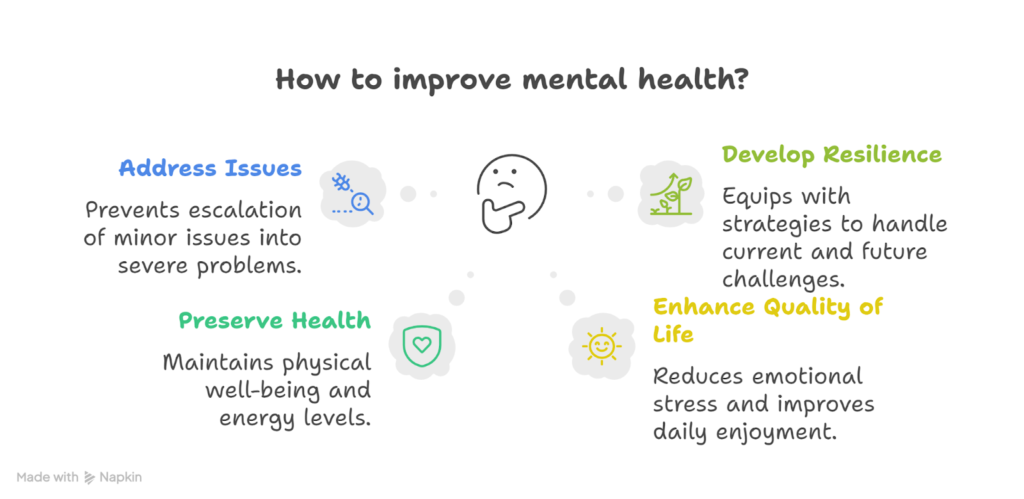
    Early intervention for unwanted thoughts and feelings can:

    • Avoid the intensity or seriousness of something bad such as conflict or tension: Ignoring minor issues might lead to more severe mental health issues.
    • Preserve general health: The immune system, energy levels, and physical health are all impacted by mental health.
    • Enhance quality of life: Receiving help early on frees you from ongoing emotional stress so you may enjoy relationships, your job, and everyday activities.
    • Develop resilience: Counseling and therapy offer strategies and resources that help you deal with present issues while also becoming ready for new ones.

    Advantages of Consulting a Mental Health Expert

    Although speaking with a mental health professional can seem like a major step, there are many advantages that go beyond simply feeling better.

    1. Understanding Your Symptoms

    First of all, you can gain crucial insight into your mental health symptoms by consulting with a mental health counselor.  You probably know you’re experiencing a mental health issue if you’ve been feeling unwell and finding it difficult to interact with others. 

    You may not be fully aware of what is happening, though.  You can get more information about your symptoms by speaking with a mental health counselor.

    This can occasionally result in a useful diagnosis, and other times it can help you better understand your feelings and how to deal with them.  Regardless of the severity or duration of your mental health crisis, being clear about what happened will help you identify

    1. Better Interaction

    Second, you will be able to communicate your mental health condition to others more effectively if you consult with a mental health counselor.

    Regular sessions with a mental health counselor will help you get used to discussing your emotions, symptoms, and challenges in a more relaxed and targeted manner.This will thus make it easier for you to discuss your mental health with individuals in your immediate vicinity.

    This is crucial because your closest friends and family members are frequently the ones who can support you during your darkest hours. But they won’t know how to support you if you never let them know what you’re going through.

    1. Increase  hope & Confidence

    You can feel more optimistic about your mental health by scheduling a consultation with a mental health counselor. It can be hard to think that you’ll ever feel better while you’re experiencing a mental health crisis.

    You may believe that your anxiety or depression symptoms will never go away.However, you will discover how to fight your symptoms and achieve healing once you begin seeing a mental health specialist. You’ll begin to see the future with greater optimism.

    How to Take the First Step

    Being willing is all that is needed to take that initial step; perfection is not. Write down your observations, including symptoms, duration, and instances of how they affect your life. Your initial appointment will be more targeted if you have this journal or symptom list.

    Ask your primary care physician for a recommendation, look out registered therapists online (verify their qualifications and areas of expertise), look into telemedicine platforms for more flexible possibilities, or get in touch with community mental health facilities. To gain a sense of fit and style, many therapists provide brief phone sessions.

    Inquire about sliding-scale pricing, insurance coverage, or local resources if money is an issue. Keep in mind that early support frequently speeds up recovery, so you don’t need to wait until things get worse. And once more, contact emergency services or your local crisis hotline right away if you ever feel uncomfortable or overwhelmed by thoughts of harming yourself.

    Conclusion
    Unwanted feelings and thoughts are a natural part of being human, but when they persist, get worse, or start to get in the way of your life, it’s obvious that getting expert help could help. Early support can help you develop better coping mechanisms, stop minor issues from getting worse, and eventually enhance your relationships and general well-being.

    It’s not necessary to wait until things become intolerable before acting. Speaking with a mental health professional is a step toward recovery, resiliency, and leading a more complete, well-rounded life—it is not a show of weakness.

    read more- Free Things to Get on Your Birthday

  • What Lifestyle Choices Can Help Reduce the Risk of Suicide

    What Lifestyle Choices Can Help Reduce the Risk of Suicide

    Suicide is not an easy topic to talk about, but it’s something that affects so many peoples ,directly or indirectly because everyone faces this thought throughout their life. When someone is directly in that dark place, it’s barely about one single reason because behind their minds a lot of thinking runs. It’s often a mix of stress, loneliness, past trauma, or even small things that pile up over time.

    Good news is that there are some real lifestyle choices that can help lower the risk. They don’t replace therapy or professional help, but they can make a big difference in your life. It builds stronger mental health and emotional balance.

    Let’s talk about a few of them in a real and simple way.


    1. Building Strong Connections

    One of the biggest factors to thinking about suicidial is having people around who care. It doesn’t need to be a big crowd or even one or two best friends can make a huge difference.

    Try to connect with friends, talk openly and don’t isolate yourself. Loneliness feeds negative thoughts, and connection helps quiet them down.Sometimes, even a small talk over coffee or a phone call with your best friends or close one you trust can change how you feel for the day.

    If you know someone who’s struggling, don’t wait for them to reach out. Be the one to send a message or drop by because he or she needs your rings.


    2. Staying Physically Active

    It sounds simple, but exercise helps more than the people expected.
    Exercise your body ,even walking 20 minutes a day – releases chemicals like endorphins and serotonin that lift mood and reduce stress.

    You don’t need to go to the gym or run. You can dance in your room, go for walks with your dog, garden, ride a bike, do yoga – anything that your body can do .

    When your body feels stronger, your mind slowly starts to follow.


    3. Eating for Mental Health

    Food is one of the ways to change your mood. When we skip meals or live on sugar and caffeine, our energy spikes and crashes and that can make emotions harder to manage.

     Lifestyle Choices

    Try to eat balanced meals in your daily routine:

    • Whole grains, fruits, veggies, and lean protein.
    • Omega-3 fats (from fish, nuts, seeds) — they support brain health.
    • Drink water. Seriously, dehydration makes anxiety worse.
      You don’t have to eat “perfect.” Just add small healthy choices, one at a time.

    4. Good Sleep Habit

    Lack of sleep changes how the brain works.It can make sadness feel heavier, and problems seem bigger.

    Try to:

    • Go to bed and wake up around the same time.
    • Avoid too much screen time before bed.
    • Keep your bedroom calm and dark.

    Most adults need 7–9 hours of sleep, but most of the time adults sleep less than expected. Even small improvements can make a real difference in mental health.

    5. Learning to Manage Stress

    We all face stress-work, family, money, life. But when it builds up and doesn’t get managed, it can lead to stress.

    Simple ways to manage stress include:

    You can’t control everything, but you can control how you respond.

    6. Avoiding Alcohol and Drugs

    Alcohol or drugs might not be good for health, but they make things worse in the long run.They mess with brain chemistry, increase impulsivity, and often make sadness or anxiety stronger the next day.

    If it’s hard to stop alone, reach out for support or consult the Dr to quit alcohol. There’s no shame in asking for help.

    7. Creating a Daily Routine

    When life feels chaotic, structure helps. Having a simple daily routine gives the brain a sense of control.Wake up, make your bed, eat breakfast, go for a walk — these small habits may not seem like much, but they ground you.
    It gives your mind something steady to hold onto, especially on bad days.

    8. Finding Purpose or Meaning

    Having a purpose doesn’t mean you need a big life goal. It can be small like taking care of a pet, volunteering, helping others, or working towards your dream.

    Purpose reminds you that you matter and that your presence adds value to the world.It’s easier to keep moving when you know someone or someone needs you.

    9. Limiting Negative Influences

    What you see, hear, and scroll through every day affects how you feel.
    Too much news, toxic social media, or negative people can quietly wear you down.

    Try organizing your space: follow accounts that inspire you, remove the ones that don’t fit you. Spend less time comparing your life to others. Real life is not as perfect as it looks online.

    10. Seeking Professional Help

    Lifestyle change means to replace therapy or medical support when it’s needed.Talking to a mental health professional, a therapist, counselor helps you understand your thoughts better and learn healthy coping strategies.

    In the U.S., you can call or text 988 to reach the Suicide and Crisis Lifeline anytime, 24/7.You’re not alone, and asking for help is not weakness. It’s courage.

    Final Thoughts

    You don’t have to fix everything overnight.Reducing the risk of suicide is about small steps eating better, sleeping better, connecting, talking, moving, and asking for help when you need it.Life can get heavy, but it can also get better .one healthy habit at a time.The key is to keep showing up, keep choosing life, even on the hard days.

  • What Does Mary on a Cross Mean?

    What Does Mary on a Cross Mean?

    Ghost’s Tobias Forge has always had a talent for fusing the most exquisite musical touches with obscene lyrical imagery. He was the only one who could make his way into the mainstream of social media with a song that, on the surface, blended pop-rock hooks with sacrilege.

    This was demonstrated by Mary on a Cross’s song viral success. A slowed-down, reverb-heavy rendition of the three-year-old song was posted by a TikTok user in September 2022 to serve as the music for a collection of Stranger Things sequences. It quickly gained popularity, and over 300,000 TikTok videos utilizing the original or modified version of the song were created.

    Additionally, it was the band’s first entry into the US Billboard Hot 100 chart and went on to become their most listened-to song, now sitting pretty with over 210 million Spotify plays.

    Ghost, Context & Background

    The band’s own mythology states that Mary On A Cross began in 1969, when an early iteration of Ghost dipped its fingers in the decade’s psychotropic waves. Even if it was portrayed by a swaggering, attractive priest named Papa Nihil, this funky Ghost from the 1960s didn’t blow the world away.

    Only after Papa Nihil returned to the band in the twenty-first century and proclaimed himself Papa Emeritus Zero were Mary on a Cross and Kiss the Go-Goat dug up and reissued as the 2019 single Seven Inches Of Satanic Panic.

    The Swedish rock band Ghost’s 2019 album “Seven Inches of Satanic Panic” included the song “Mary on a Cross,” but it wasn’t until a bit later that it began to gain popularity. A slowed-down version of the song went viral on TikTok in 2022, and fans used it as the background music for many modifications of their favorite shows.

    What Does Mary on a Cross Mean?

    You could initially assume that the song is about Mary, the mother of Jesus. The song is not religious at all, but its chorus seems to allude to a sexual act by using religion in a completely other way.

    The chorus’s lyrics, “You go down just like Holy Mary, Mary on a, Mary on a cross,” are undoubtedly a reference to oral sex. The “real meaning” of the song is probably not that unexpected if you know anything about Ghost. According to The Independent, frontman Tobias Forge is basically a self-described modern Satanist, which makes the innuendo in the songs less alarming.

    Multiple Interpretations & Misunderstandings

    However, Tobias Forge has discussed the song, and it appears that it has been misunderstood. In an interview with Brann Dailor of Mastodon (via YouTube), Forge explained how his child’s buddy had heard that the lyrics to “Mary on a Cross” were “perverse,” which led Forge to elaborate on how the lyrics aren’t what they seem.

    “There are a few, there are multiple layers of the lyrics — it might be important for people to understand that,” Forge explained. “The chorus is written very tongue-in-cheek, of course. ‘Go down’ doesn’t necessarily mean as in a 69 sense of the word. It can also mean ‘go down’ as in ‘go down in history, your own ascent.’”

    According to Forge, the song alludes to individuals like Mary Magdalene whose motives have been misinterpreted. Nevertheless, as was indicated in the discussion above, the song has drawn a fair amount of criticism from people who find the lyrics insulting. In a subsequent Cutter’s RockCast broadcast, Forge addressed this matter once more, stating,

    “Of course, that is the backside of it, people hearing it and finding it, like, deeply offensive and this that or the other, just because they didn’t have the brain capacity to sort of realize what it is about.”

    The Band’s Lore and the Song’s Hidden Context

    It’s possible that Tobias Forge’s discussion of the “multiple layers of lyrics” with Brann Dailor alluded to the enduring narrative that Ghost incorporates into their songs.

    For those who are unfamiliar, TikToker @darkcodedarti shared a video that explains the history of “Mary on a Cross.” There are two people in the lore: Sister Imperator, who Planet Radio refers to as “the head of the Satanic clergy of Ghost,” and Papa Nihil, who is Forge’s alter ego. Sister Imperator was once a lover of Papa Nihil.

    The song was inspired by the imaginary couple’s reunion after they saw another music video called “Dance Macabre,” according to @darkcodedarti’s theory.

    Conclusion

    Mary on a Cross is still one of Ghost’s most popular and contentious songs; it’s an intriguing fusion of obscene imagery, unclear narrative, and emotional undertones. Even though Tobias Forge has made it clear that it is neither exclusively sexual nor exclusively spiritual, the fascination is nonetheless fueled by the multiple meanings and interwoven stories.

    Mary on a Cross demonstrates Ghost’s ability to make the sacred and profane dance together, solidifying their place in both rock history and contemporary online culture, regardless of whether it is seen as satire, storytelling, or spiritual metaphor.

    Read More- https://dev.journalingtechniques.org/blog/free-things-to-get-on-your-birthday/